


 21.08.2025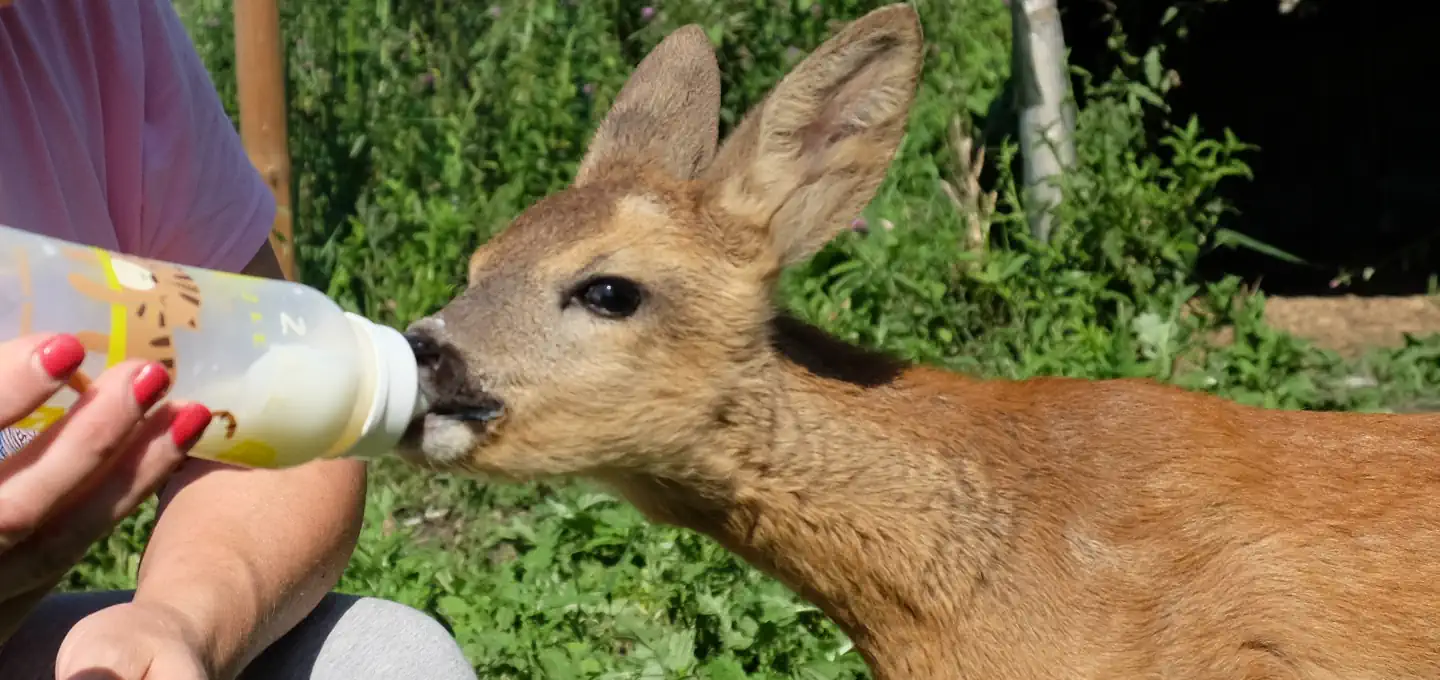
“Can we climb up here?” I ask in the tone of a six-year-old child near the wooden stairs hidden in the crown of a pear tree.
“Sure, climb up,” says our guide, biologist Volodymyr Buchko. Hidden in the branches, there is a platform and a table with a bench.
“I drink coffee here in the evening and watch animals come out into the open. There’s a ram over there and a deer…”
From the terrace on the pear tree, you can see the hilly western Ukrainian steppe, the Burshtyn Reservoir, and scattered thickets where deer, mouflons, and other animals hide from the heat. Kasova Hora Ecosystem Conservation and Restoration Center is located near the city of Halych in the Ivano-Frankivsk region, where Daniel of Galicia is a Ukrainian historical figure and the king of Rus’ (from 1253). He is described as an exceptionally gifted ruler, who built a number of cities (including Lviv), reformed the military forces, and brought European cultural influences to Ukraine. Adapted from: Internet Encyclopedia of Ukraine.Daniel of Galicia once lived. Volodymyr appears to have as much right to be proud as the king, for his long-held ambition has come true here: Ukraine’s largest ungulate rehabilitation center, where animals recover and restore the steppe.
“Just mow it”
There is no entrance fee, but there is a donation box and a charity account. Right at the entrance, fallow deer are resting in the shade. They spot us and jump up. As we ascend higher, the chimneys of the 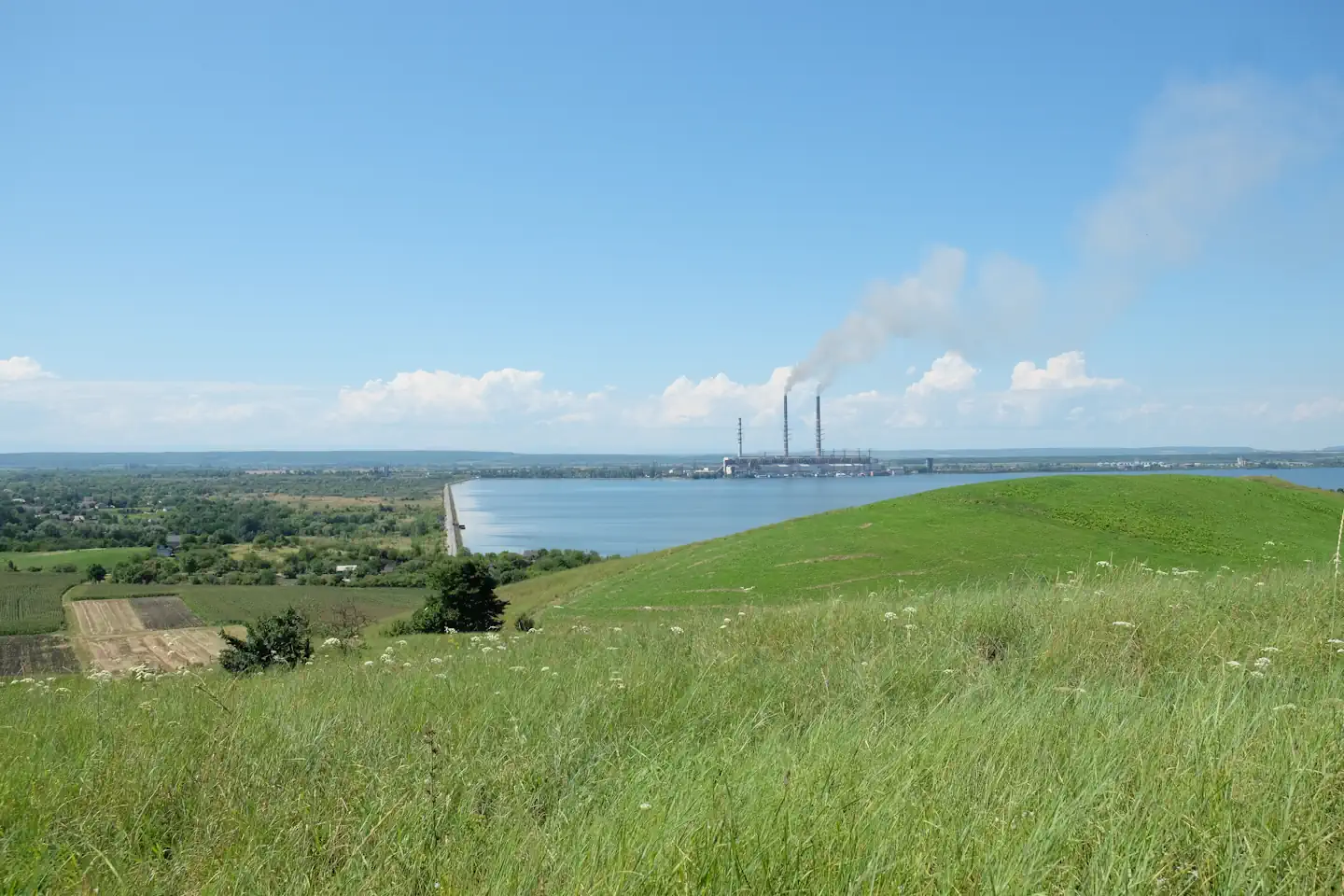 Burshtyn TPP is a coal-fired power plant located in the Ivano-Frankivsk region. Source: Wikipedia.Burshtyn TPP and the blue reservoir on the Hnyla Lypa River appear on the horizon.

The Gorgany Mountains stretch across the skyline. From Kasova Hora (hora means “mountain” in Ukrainian), you can see far into the distance.
Where does the name Kasova come from? In Ukrainian, it means “cash register.” What could that possibly have to do with a mountain? Locals tell a story that Daniel of Galicia once hid his treasure in one of the many caves here. However, it is more likely that the name comes from the word kosovytsia (“haymaking”). And haymaking plays an important role here!
But even if the treasures are really here, there is also a more valuable and undiscovered treasure—a rare natural area.
Kasova Hora is the largest fragment of meadow steppe in the region. “This is the benchmark for the Western Ukrainian steppe. There are other areas like this one, but they are very small,” explains Volodymyr, confidently strolling through Kasova Hora in his Crocs. “The ecosystem here is very rich. There are 380 species of vascular plants, more than 30 of which are listed in the The Red Book of Ukraine is an official national red list of the threatened animals, plants and fungi that are protected by the law in Ukraine. Source: Wikipedia.
Red Book of Ukraine.”
Vsevolod Levytskyi, a nature conservation specialist of Shevchenko Scientific Society is a Ukrainian scientific society devoted to the promotion of scholarly research and publication, founded in 1873. Source: Wikipedia.Shevchenko Scientific Society in Lviv, was the first to want to protect this steppe. In 1936, he wrote a letter to the Metropolitan of Galicia and the Archbishop of Lviv,
Andrey Sheptytsky is a priest and theologian of the Ukrainian Greek Catholic Church who served as the Metropolitan of Galicia and the Archbishop of Lviv from 1901 until his death in 1944. Source: Wikipedia.Andrey Sheptytsky, asking him for the land of Kasova Hora, which at that time belonged to the church. Scientists and representatives of the Greek Catholic Church gathered at a conference and jointly decided to create a nature reserve on Kasova Hora. However, World War II thwarted these plans. During the Soviet era, a nature reserve was created here after all. Initially, 7 hectares were protected, and since 1988, 65 hectares have been protected.
In other areas, people mowed hay. However, where the deer now graze, sheep were kept until the 1990s. Plowing was impossible here, as limestone and gypsum come to the surface, so a plow cannot pass. This is what saved this piece of the steppe from destruction.
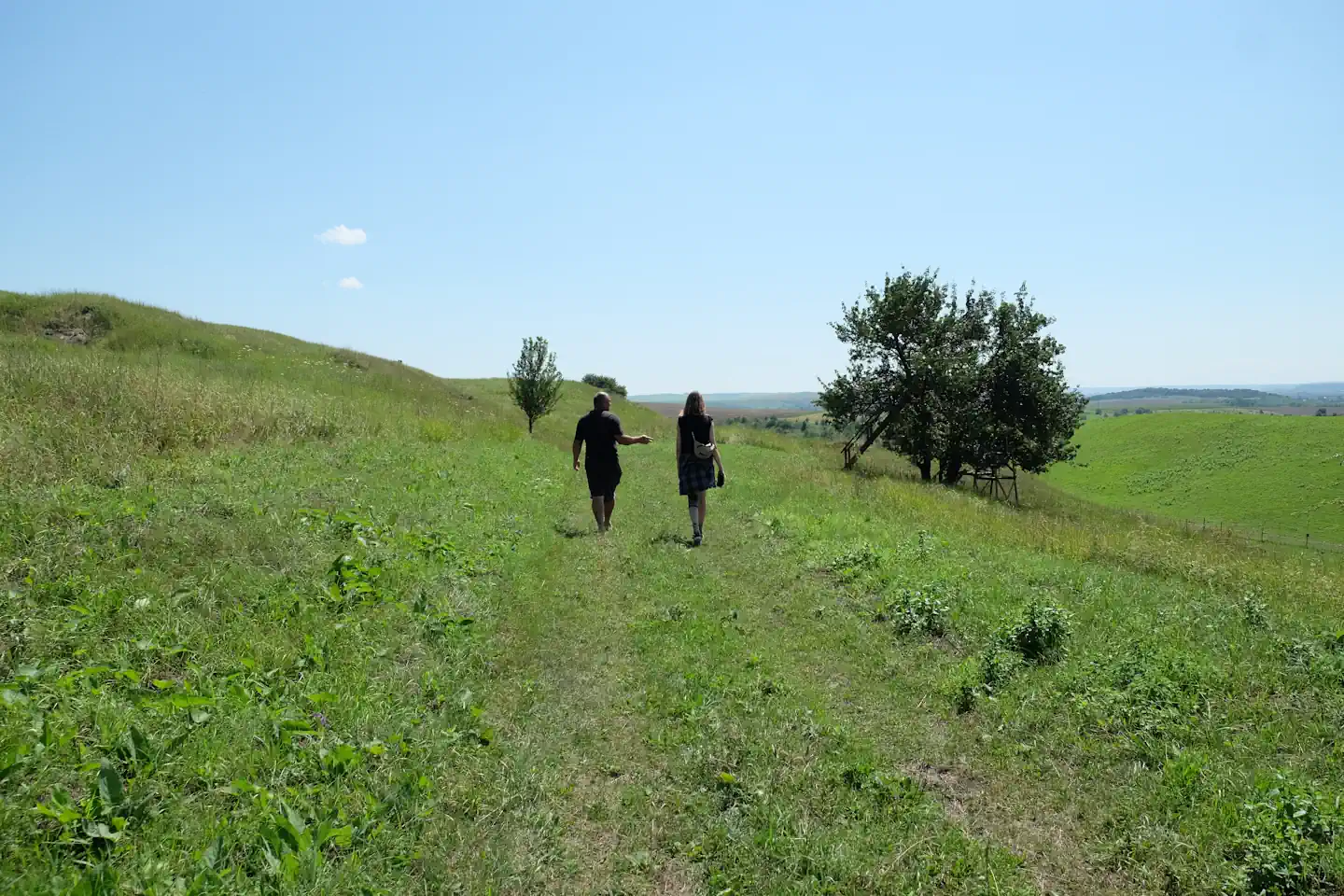
In 2019, renowned botanist Yakiv Didukh visited Kasova Hora, Volodymyr recounts. He did not recognize it. The steppe had become extremely overgrown, leading to thickets and invasive species. Soon there would be nothing of value left in terms of nature conservation.
“I said we would preserve it,” recalls Volodymyr. “And Yakiv replied, ‘Take a scythe and just mow it.’” It was impossible to mow so much. That’s when I came up with the idea of creating a rehabilitation center for ungulates.
“So that they could graze and take care of the area?”
“Exactly!”
Teeth and horns vs. thickets
By eating trees and shrubs, ungulates preserve the steppe. Otherwise, the area becomes overgrown. Then, valuable species disappear, replaced by invasive species that are not characteristic of the steppe.
Volodymyr’s idea to bring ungulates to Kasova Hora was supported by IFAW, which financed the initial costs. Scientists organized an expedition there. Together, they created a project on how to manage the territory. In 2023, the Burshtyn City Council supported the project and leased the land to Volodymyr Buchko for 20 years so that the plan could be implemented under his leadership.
The restoration of an ecosystem to its original state is called rewilding. At Kasova Hora, this process was carried out by ungulates, or rather their teeth. Kasova Hora is a two-in-one project: the rehabilitation of ungulates that had previously lived in unsuitable conditions and the restoration of the steppe.
In addition, species that previously lived in Podillia is a historic region in Eastern Europe located in the west-central and southwestern parts of Ukraine and northeastern Moldova. Source: Wikipedia. Podillia are being returned to the wild here. This is a reintroduction.
Volodymyr, his wife—botanist Lesia Buchko— and one hired staff member work on the wide terrain. Volodymyr is presently serving in the military, thus he can only visit the reserve while on leave. It would be difficult to function without volunteers.
“UAnimals coordinates volunteers for us. And now I’ll show you how they’ve helped us!”
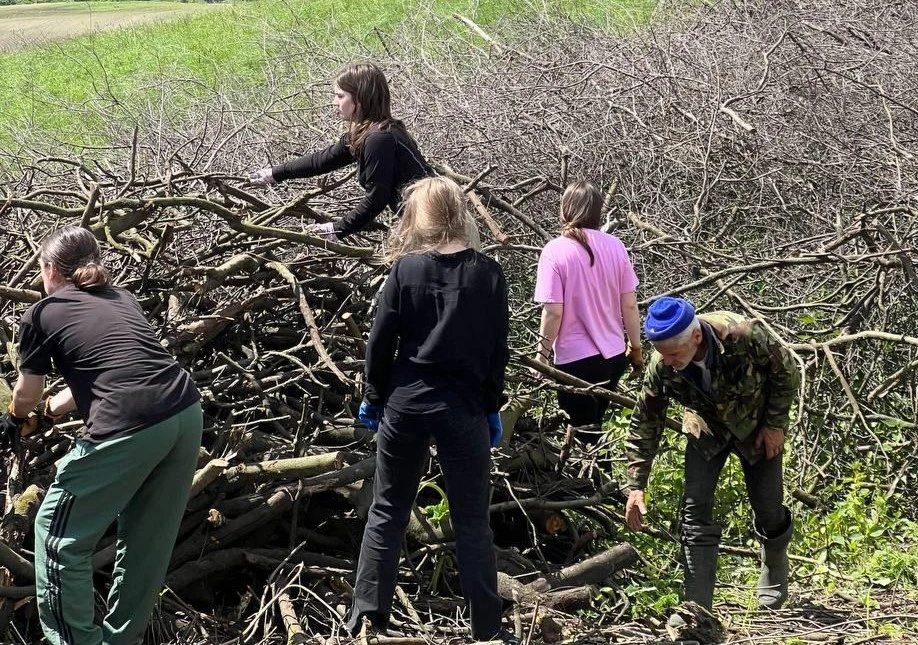
Ukrainian volunteers often come to various reserves and shelters to help animals and nature in Ukraine.
Doing good things helps not only others, but also supports your emotional state.
Visit UAnimals website to find out what good things you can do for animals in Ukraine.
Volodymyr leads us to an area where cut bushes and trees are visible. This area has been cleared. Most of the branches and logs were removed by the volunteers. There are three such areas at Kasova Hora. Botanists have taken notes on them and will now monitor how the steppe gets restored in these places.
Volodymyr crouches down next to a gnawed sapling. “This tree has dried up, and that’s a good thing. Male European roe deer rubbed their antlers against it and stripped off all the bark. That’s why the tree died. We allow individual trees to grow, but if there are too many of them, the steppe becomes overgrown. If you cut down a tree, the undergrowth remains and continues to grow. But here, everything has been gnawed away, so it won’t grow anymore. In other words, roe deer regulate the ecosystem.”
Peter, Vasyl, and who else?
There is a roe deer in a small quarantine enclosure. However, this animal has not yet started working on the ecosystem. He looks like a small goat and runs to a bottle of milk to suck eagerly. “This is little Peter. He was found on Peter and Paul Day, so that’s what we named him,” says Lesia.
There are eleven roe deer at Kasova Hora. They were handed over from private keeping. “They all have the same story,” Volodymyr complains. “People come to the forest, see a baby roe deer, and take it home. The deer grows up and starts eating everything. And then we are asked to take it away, as soon as possible. No matter how much you explain that you can’t take babies from the forest, people still can’t resist doing it!”
In the neighboring enclosure, Vasyl, a deer from Boryspil, was also brought from private keeping. Right now, the deer is resting in the shade.
“Why is he in quarantine?” I ask.
“He got into a fight with another deer. We’ll release him soon. He’s actually phlegmatic and tame. When he was brought, he just stood there and didn’t want to leave the cage. To get him to walk out, you had to push him from behind. He’s terrified of machinery. Maybe he was in some kind of accident.”
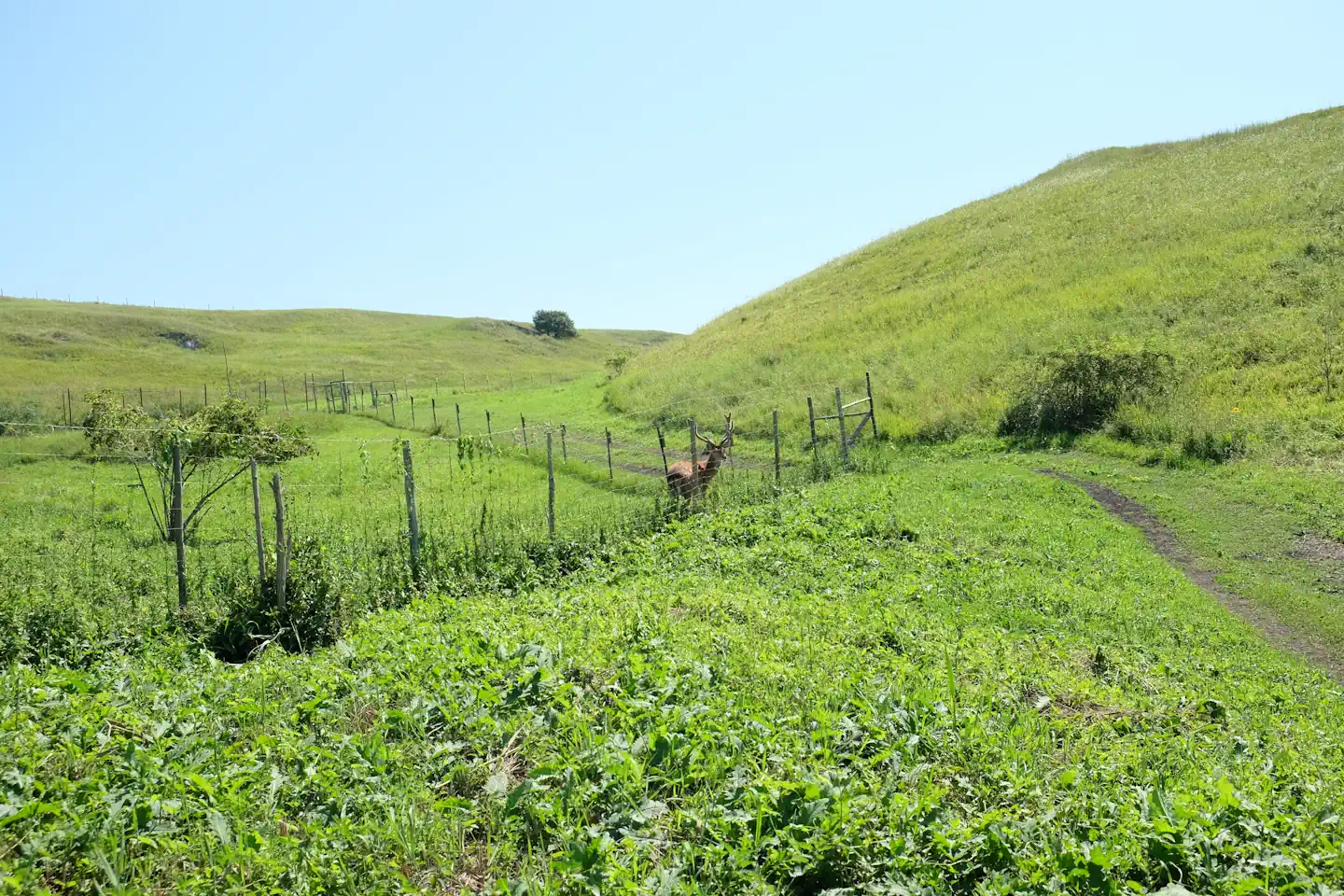
Vasyl in quarantine
The rest of the animals roam Kasova Hora wherever they want. However, the area itself is limited, covering just 23 hectares. This is how much land Volodymyr has been able to fence off so far. The ungulates live here in conditions close to their natural ones. They hide from people, and it is not so easy to see the animals.
“Kids come here and say, ‘We want to see the animals,’” shares Volodymyr. “I always tell them that this isn’t a zoo. Wild animals live their own lives, but you can walk around and look for them. Maybe you’ll find them, but no one can guarantee you that. It’s a kind of quest in itself.’”
The ungulates to the foreground
I love quests, so we continue on our way. Ahead, a reddish, curious head peeks out from the grass. It is a female Przewalski’s horse.
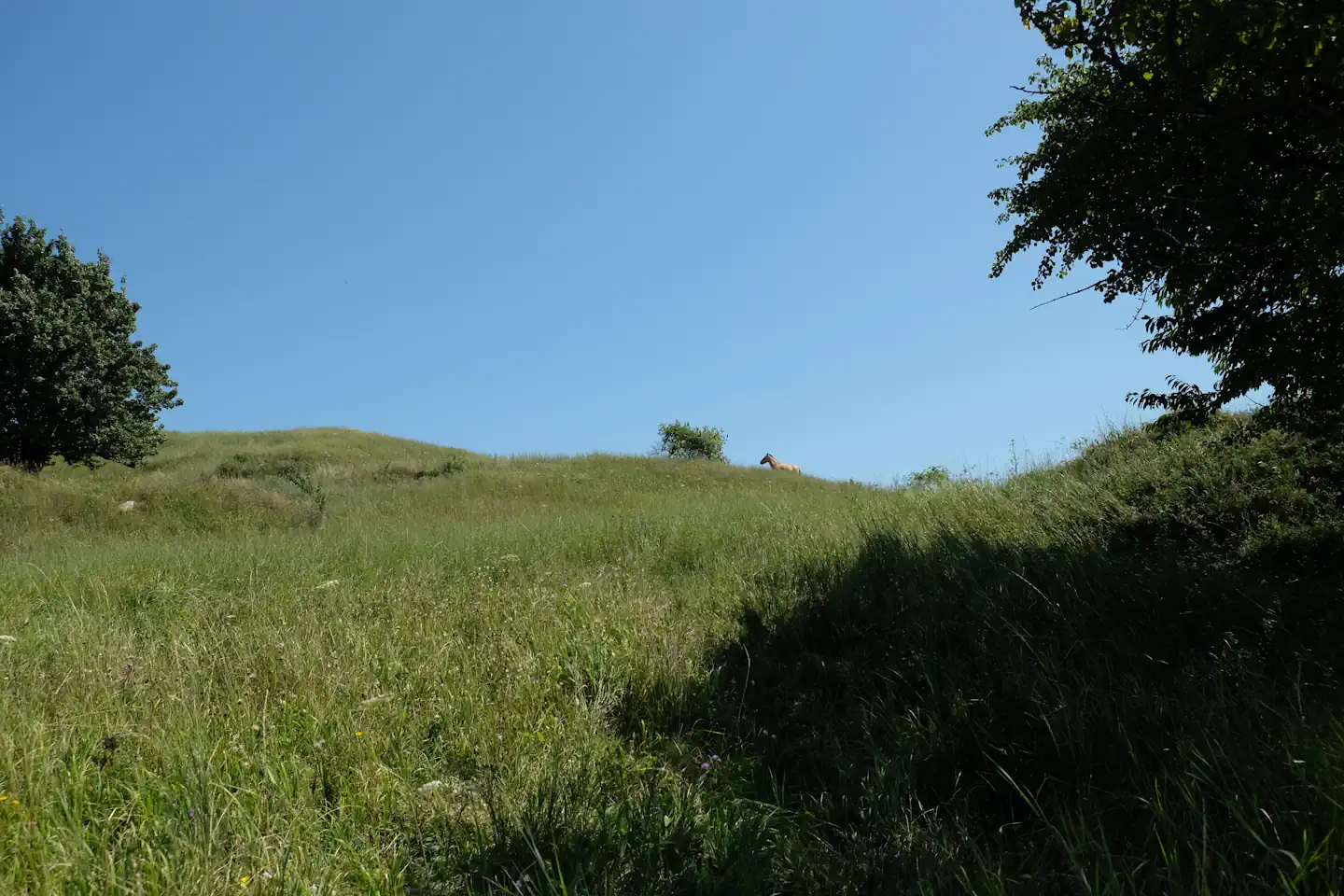
She was the first resident of the center and settled here with the help of UAnimals. She used to live in the former hunting residence of Ukraine’s ex-president, Viktor Yanukovych is the fourth president of Ukraine, from 2010 to 2014. Yanukovych was removed from the presidency during the 2014 Revolution of Dignity, which followed months of protests against him. Since then, he has lived in exile in russia. Source: Wikipedia.Viktor Yanukovych. There is now a recreation park there.
The animal had a fiery temper, so in the spring of 2022, the staff decided to put her down. Concerned people intervened, and UAnimals joined to support the animal. The organization paid for sedation, veterinary care, and transportation of the animal to the Ivano-Frankivsk region. She lived for another year at the stadium in the city of Burshtyn, as there was no enclosure yet for her at Kasova Hora.
Her neighbors are a herd of nine northern spotted deer that used to live in the Lviv region in a cramped enclosure of a recreation center. The place went bankrupt, and there was no one to take care of the animals. UAnimals, together with Volodymyr, transported them to Kasova Hora, where the deer now have incomparably more freedom. Later, one of the females gave birth to a fawn, so now there are ten animals in the herd. They share the vast territory of Kasova Hora with two other spotted deer, three European fallow deer, four mouflons, and eleven European roe deer.
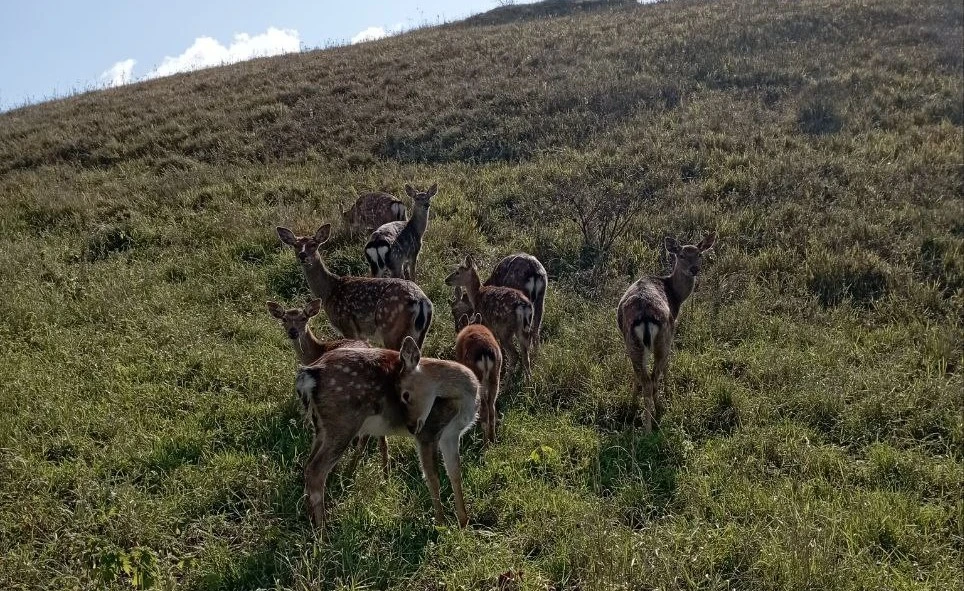
Behind every animal rescue story is human support
Wild animal transportation frequently requires anesthesia, specialized equipment, veterinarians, and, of course, fuel and drivers. That is why transferring a deer or a mare to a rehabilitation center requires donations.
Perhaps you, too, are eager to support UAnimals’ work?
The animals do not reproduce at the center, so during the mating season, males and females get separated. To do this, they are lured into a special enclosure with food. “They went in and moved in a circle. At one point, the whole herd came in, and I closed the door,“ explains Volodymyr. “The male approached the edge, so I got him in a cage and released him in a different area.”
The animals receive basic care. They are vaccinated and treated for ticks (after being lured into the enclosure, the herd gets sprinkled with powder that protects against parasites). In winter, they are given a bit of oats and corn. In summer, they are only given salt licks. Everything else is as it is in nature.
Souslik’s comeback: How spotted ground squirrels get reintroduced
The tin fence glitters in the sun, almost hurting the eyes. “And this is a souslik’s nest,” Volodymyr explains.
Seventy years ago, Kasova Hora and the surrounding area were full of them. Ihor, an animal expert from a local village, said that sousliks lived in the area, and he used to chase them with his friends when he was a child. The spotted souslik is more widely known as the spotted ground squirrel (Spermophilus suslicus). In Ukraine, this species is on the verge of extinction.
People were deliberately eradicating spotted ground squirrels because they caused significant damage to farms and gardens. In addition, spotted ground squirrels need steppes and meadows to survive. These are also disappearing. Unplowed land is being plowed, resulting in fewer livestock to graze and clear the overgrowth. Just a little while later the species might have vanished from Ukraine entirely. Scientists are currently working to restore it, including here at Kasova Hora. UAnimals supported the entire spotted ground squirrel reintroduction initiative.
The spotted ground squirrels that settled at Kasova Hora came from the Lviv region. The area where they lived with others of their kind was partially plowed. Experts caught several animals there and relocated them to Kasova Hora.
The so-called nest of the spotted ground squirrels at Kasova Hora manifests as an area surrounded by a metal fence. In the center of it, there is a smaller mesh enclosure. The animals lived there for two weeks, getting used to their new home. Then this mini-enclosure was opened, and the spotted ground squirrels went to explore the half-hectare adaptation enclosure.
Won’t they dig under the fence? No, because the metal is 50 centimeters deep in the ground. There is also a camera there to observe how the animals are settling in. Soon, a camera with a greater zoom will be installed.
A ground spotted squirrel scurries through the grass, but unfortunately, I am too busy examining the camera. The burrows and tunnels are clearly visible, with sunflower husks scattered here and there. “They’ve eaten everything,” Volodymyr inspects. “We give them sunflower seeds, which are quite fatty. The animals need a lot of fat to survive the winter. In nature, they eat seeds and hunt for beetles: grasshoppers and locusts.“
The spotted ground squirrels have been living here since June 1. Later, they will leave this enclosure and live at Kasova Hora, wherever they like. Volodymyr and those involved in the project want the colony to grow to at least 500 animals. For now, these few are being protected from predators.
An electric fence has been installed around the enclosure for this purpose. “If a ferret or a fox comes along, it will sniff it, get shocked, and run away. And we have a scarecrow to scare away birds,” Volodymyr points out.
Even I am scared of this “man” as he moves eerily in the wind.
“I made it move on purpose. The ground spotted squirrel’s biggest enemy is the lesser spotted eagle. It will see a person and not attack. So this ‘man’ protects our colony well.” I take a picture of Volodymyr with the scarecrow. “You can call it ‘The Two on Guard for the Spotted Ground Squirrels.’”
The Golden Fleece of Kasova Hora
We stroll along the hills and discover feather grass. These long, flexible stems are an essential component of the steppe. This one is golden feather grass (Stipa pulcherrima). In addition, there are three other varieties of feather grass present: dwarf feather grass (Stipa capillata), horsetail feather grass (Stipa tirsa), and European feather grass (Stipa pennata).
Volodymyr picks up a bit of wool shed by a mouflon. “Look, here’s the Golden Fleece. Feather grass attaches to the wool, and sheep transport the seeds. And in the mix, we can observe a rare plant, Euphorbia volhynica, which has already blossomed.”
Euphorbia volhynica is endemic to Eastern Europe (it grows only there and nowhere else in the world). It is also a relic, a plant that existed from prehistoric times, when nature was very different. It bears witness to earlier eras.
We encounter the pheasant’s eye (Adonis vernalis). Without the blossoms, it resembles dill. It’s also known as the yellow pheasant’s eye due to its vivid yellow color. The plant is used to produce heart medicine. However, you cannot use it to brew a cup of tea for yourself. It is toxic.
Here and there, Chamaecytisus podolicus grows. It is also a local endemic species that loves rocky slopes. It is protected by international nature conservation lists. The spiky fescue underfoot feels good to the touch.
We are in Opillia, the westernmost part of the region. During past geological eras, seas covered these highlands. Gypsum and limestone formed at the bottom, resulting in rocky slopes. These places were not cultivated, therefore they became relics (they were little affected by humans and preserved many species). These are the region’s richest ecosystems, with the greatest diversity of animal and plant species.
We climb to the top. It is windy. A Eurasian goshawk is hunting above us. From the observation tower, you can see how fragile this beauty is. Right behind the fence, soybeans grow thickly, corn is visible below, and the neighboring hill is covered in bushes. “There used to be steppe on that hill too,” Volodymyr points out. “But now it’s overgrown. Either it will be plowed up, or it will turn into low-value forest.” Such forests are not rich in terms of biodiversity. There are few species of plants and animals there.
We descended for a while through purple moor grass and eagle fern. These are undesirable species here. They are not characteristic of the steppe and grow densely, suppressing other plants. “We mow the fern, but it just grows back.” Dane weed and the European dewberry are also a nuisance. Hoofed animals do not eat everything. They avoid dane weed because it smells bad to them.
“This is a bad spot,” Volodymyr nods at the eagle fern and dewberry. “But these slopes are great.” They are gray with feather grass. Przewalski’s mare appears again and watches us with her shiny dark eyes.
Beyond ungulates and spotted ground squirrels
We sit down near some piles of earth. They look as if a small excavator had been at work there. In fact, this is the work of the Podolian mole-rat (Spalax zemni). It is an endemic species, found only in the region of Podillia. It is truly blind. Its eyes shrunk because it does not need them, as it lives underground. According to a local legend, when the mole asked God to give him sight, God ordered it to dig as many piles of earth as there are stars in the sky.
Instead, the Podolian mole-rat has long incisors, which it uses to gnaw passages in the ground. It eats the underground parts of plants. It lives alone and only meets other mole-rats to reproduce.
At Kasova Hora, “the population has miraculously survived,” says Volodymyr. There is another one in the Mykolaiv region.
Among the mammals on the mountain, there is also a team of nine hares, all undergoing rehabilitation, from different parts of the country.
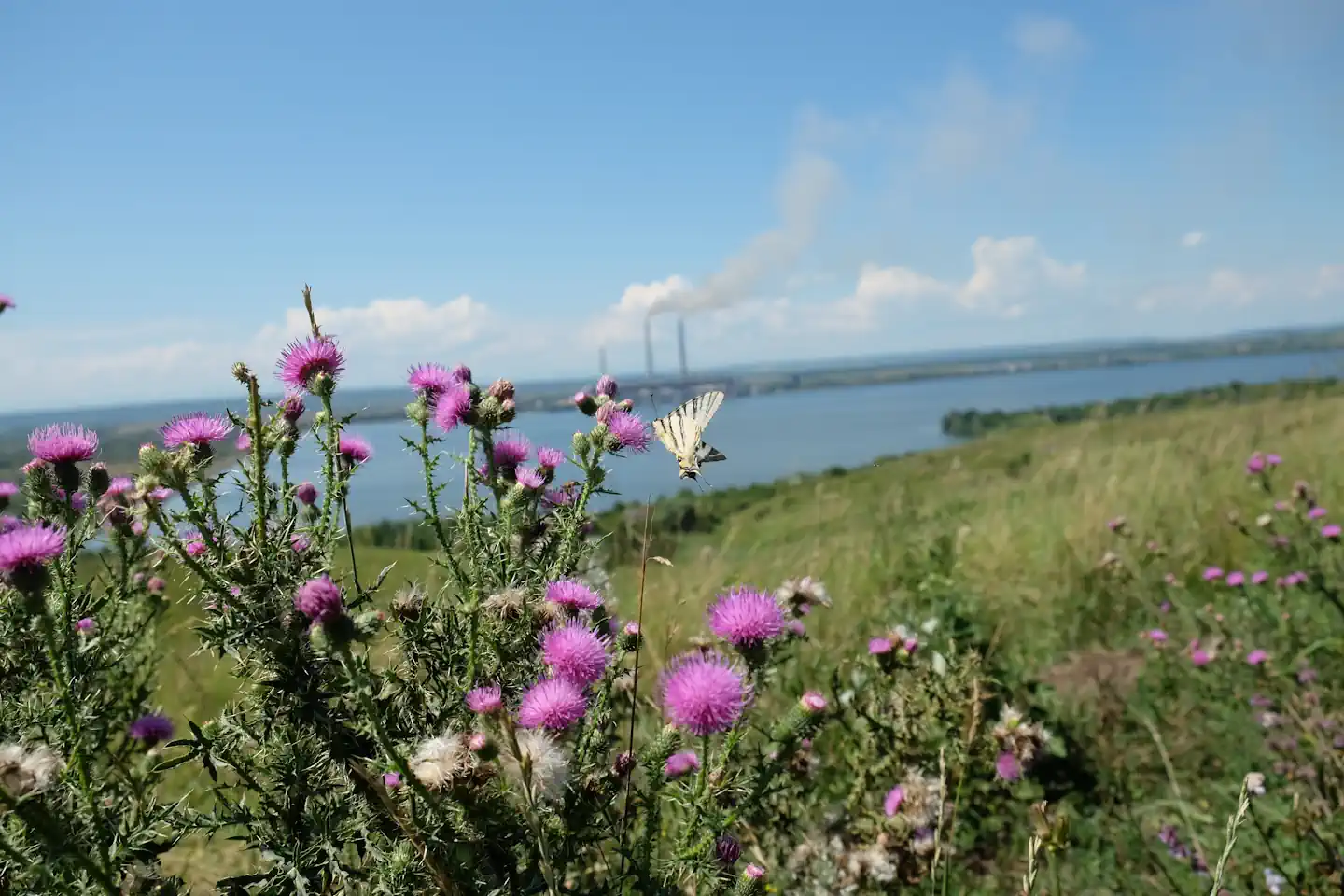
Where there are many plants, there are also many insects. A rare purple bumblebee lives at Kasova Hora—the splay-footed carpenter bee (Xylocopa valga). The female builds containers from pollen for each of her eggs. At the bottom of the hill, there are wooden houses ready to welcome this rare insect.
In addition to bees, Kasova Mountain is home to the Ukraine bright bush-cricket (Poecilimon ukrainicus), which is a wingless grasshopper. Only a few individuals remain in nature due to the disappearance of the steppes. Therefore, it is listed in the Red Books of Ukraine and Poland.
Another wingless grasshopper is the predatory bush-cricket (Saga pedo). They are a girls-only club. Males exist in nature, but they are extremely rare. Reproduction occurs without their participation. New insects develop from eggs without fertilization. This type of reproduction is called parthenogenesis. Grasshoppers are predators, catching other insects from ambush.
We wander through the grass to the wild apple. Finally, a bit of shade! Volodymyr searches the ground for a ripe apple, but there is nothing there. Finally, he picks one from a branch.
“You see, the ungulates eat everything. The apples are tart, but they like them. A badger also comes here to eat. He used to live in abundance here, but poachers constantly caught him. Now they can’t do it!”
In the collapsed slopes of the mountain, there are burrows of the European bee-eater, the sand martin, and wild bees. Volodymyr and an employee created one such place for birds by hand, using shovels. Birds have indeed settled there.
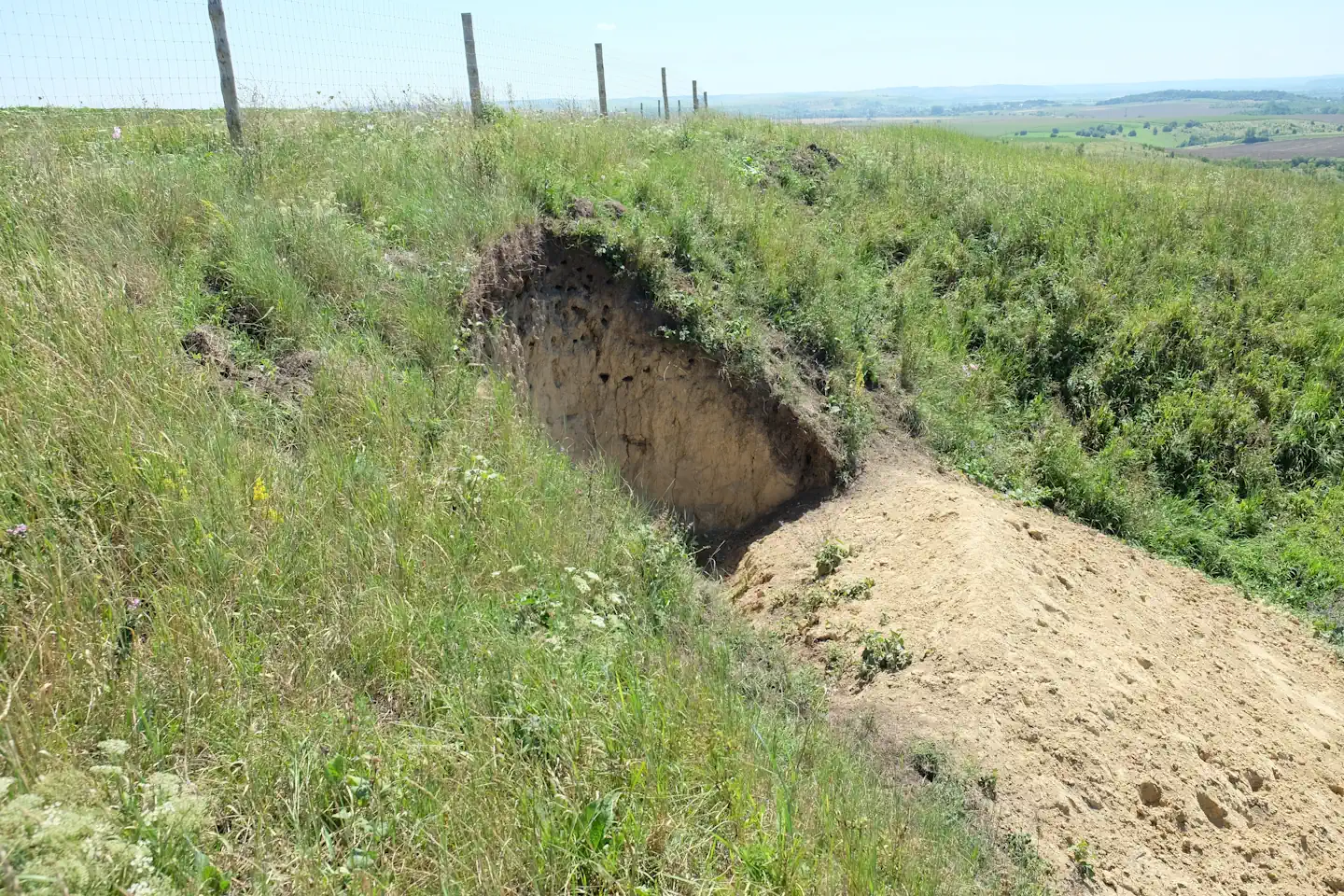
The collapsed slope of the mountain, where there are burrows of the European bee-eater, the sand martin, and wild bees.
While I am looking at the feather grass, I am called down to another solitary tree. It turns out that there is also a cave there. “This is the cave of the peacock butterfly. They hibernate there, and lots of them gather here,” says Volodymyr, settling down in the shade.
The peacock butterfly is a red butterfly known to all of us, and its Latin name is Aglais io, in honor of the beautiful Io, one of Zeus’s lovers.
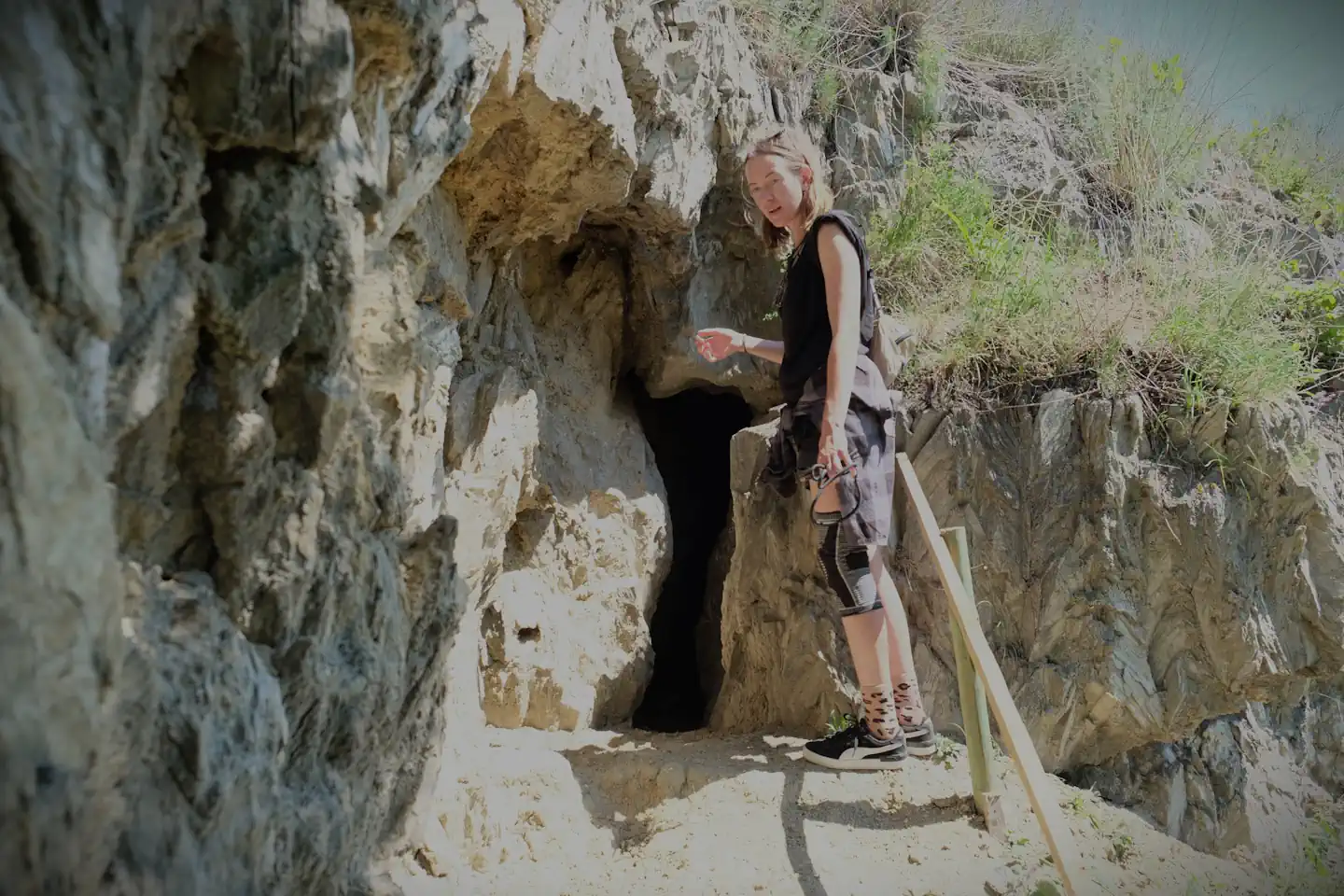
The cave of the peacock butterfly
A camera trap is hidden in the crown of a wild pear tree to monitor which birds fly here. Magpies, great grey shrikes, Eurasian goshawks, lesser spotted eagles, and thrushes are captured on camera.
Another observation point is located on a different pear tree. We climb a wooden ladder to a small terrace right in the crown of the wild pear tree. For Volodymyr, this is also a place for coffee and reflection.
Brainstorming on a tree
“There’s plenty of work to do,” says Volodymyr, leaning back on a bench where a pleasant breeze finally cools the heat. “Right now, I’m building a field kitchen for volunteers. You know, the kind with big frying pans so you can cook potatoes, just like at home.”
The man plans to set up an enclosure for animals that live in water. There have already been four cases where rescued otters could have been settled at Kasova Hora. However, there was no space, and the otters had to be sent elsewhere.
However, the main difficulty is to fence off the other areas of the plot. Volodymyr currently leases 71 hectares of property, 23 of which have already been secured with a fence. If the same is done in other sections, males can be separated from females during mating season, and animals that cannot live together in a single enclosure, even if it is huge, can be allowed. “Someone asked me to take the red deer, but I couldn’t. He would attack everyone up here.”
By fencing off the second plot, according to the plan, the center will be able to accept another 50 ungulates.
“Everyone benefits from the existence of the center here. The community benefits because I preserve degraded land and pay land tax. And I am happy because it was my dream,” says Volodymyr.
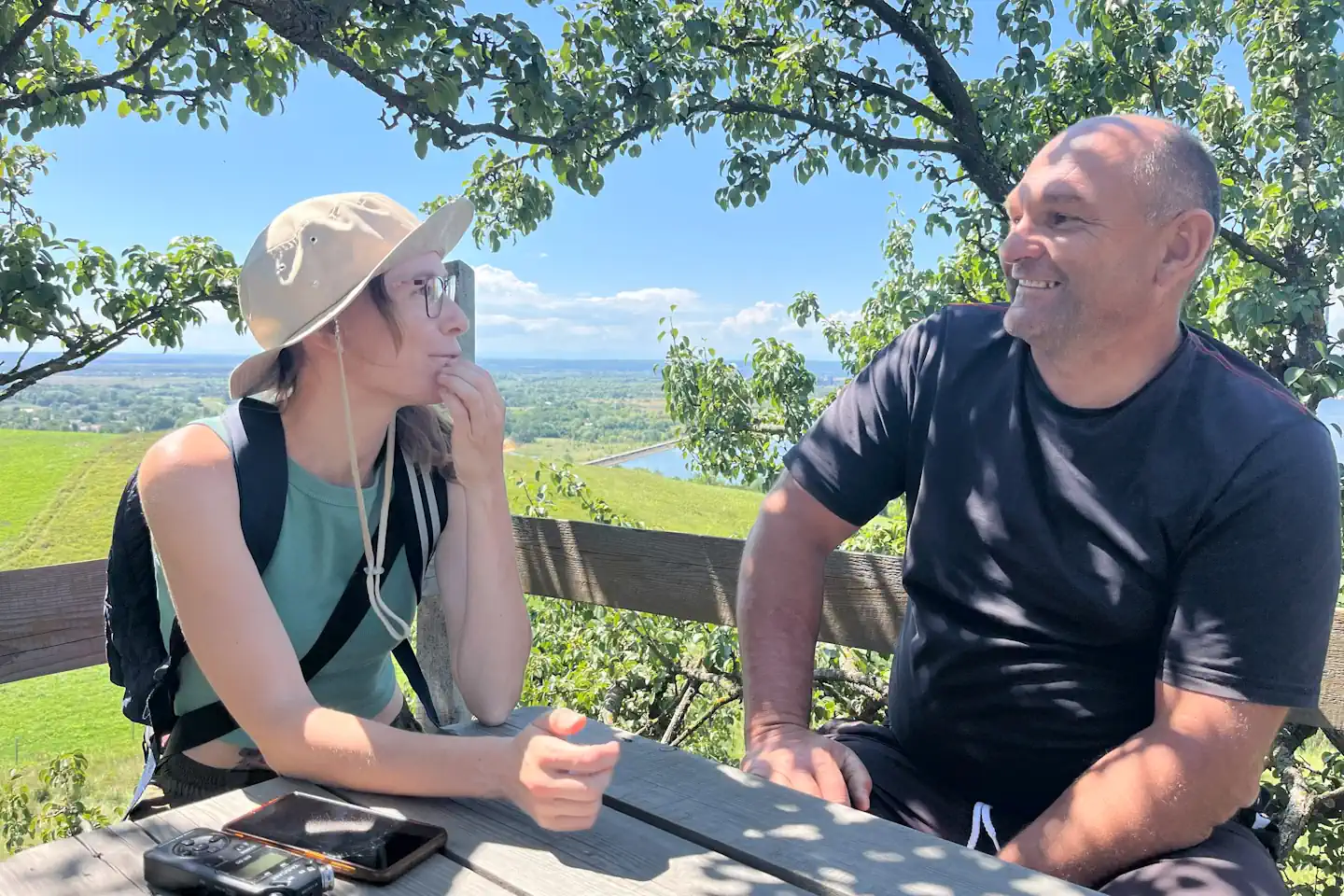
Volodymyr and Natalia on a tree
Nowadays, tourists visit Kasova, and distinguished guests come here. However, not everyone is satisfied. Some people really want to see the animals, but this is not always possible. The animals do not sit around waiting for visitors.
School kids also come here. The local schools have introduced outdoor lessons at Kasova Hora for various grades, starting with the 6th grade. “First, we have a tour, then we sit down and talk with the children,” says Volodymyr. “We teach them to be compassionate towards wild animals. We show them how animals should live. Wild animals should live in the wild.”

Have you read till the very end?
It appears that you’re interested in our materials. Please consider donating so that we can continue. Thanks to your contributions, we will be able to create more interesting and useful pieces.
Content


