



 30.07.2024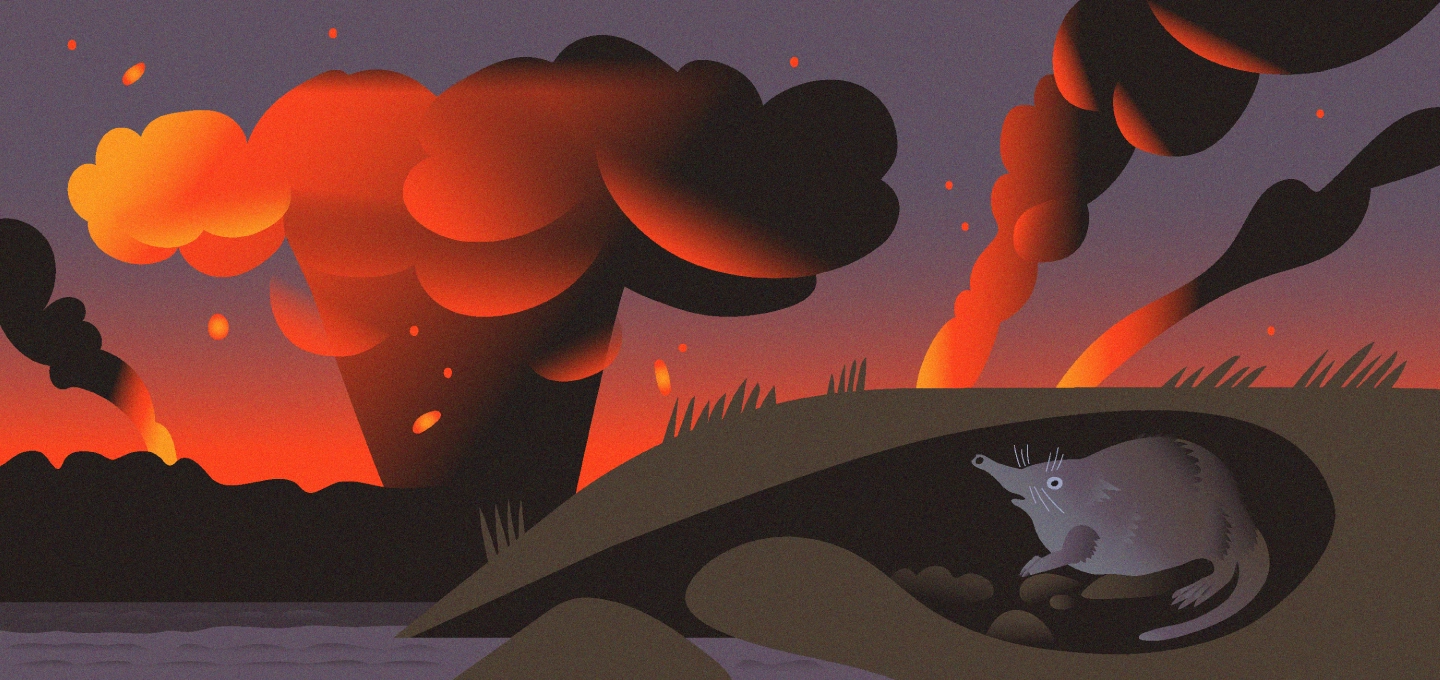
“It was the end of the day, the sun was setting. Luckily, we were rowing: leisurely paddling along. Suddenly, we saw it sitting there! It was gnawing on something on the water lilies. It noticed us, too — the contact lasted about 5 seconds. Then it immediately dived and hid under the lilies.”
Zoologist Oleksandr Yemets, a researcher at the Seymskiy Regional Landscape Park, has been studying the desman for many years. He has seen it in the wild only once in his life, and he says he was incredibly lucky.
The animal is so rare that all possible conservation documents protect it. In the Red Data Book, it has the status of a relict species at risk of extinction.
Moreover, the desman is very cautious. Upon sensing an intruder, it will dive to the bottom, sealing its snout with special valves. Then, it might even relocate from the area where it was disturbed.
The problem is that in modern conditions, the desman is disturbed everywhere — and in Ukraine, it is almost extinct. The only population of desmans remains in the The Seym is the largest tributary of the Desna. In Ukraine, the river flows in the Sumy and Chernihiv regions.
Seym and its two tributaries.
Now, this area has become a battleground: explosions can constantly be heard in the once-quiet backwaters. So, does the desman still live near the Seym, and what do we know about it? We discuss this as part of the #StopEcocideUkraine project.
The Russian Desman — The Oldest Representative of Modern European Fauna
The desman is a small mammal that spends much time in the water. Its lifestyle is similar to that of a muskrat, but by origin, the animals are not closely related. The desman is related to the mole. In the Talpidae family, which includes moles, there is a genus called Desmana. A single species of this genus still survives, the Russian desman, scientific name Desmana moschata. Once, there were many species of desmans, but we know this only from fossil remains.
The oldest remains of these animals, found in Europe, date back to the Miocene. This was an epoch in Earth’s history that began about 23 million years ago and ended about 5 million years ago. The animal world was quite different then. The desman lived alongside the ancestors of horses, rhinos, and immense mastodons. Humans as a species did not yet exist!
Therefore, the desman is a relict animal that has survived into modern fauna from pre-human epochs and is not well adapted to current conditions. It evolved into its present form 20 million years ago and has not changed since. Why change anything?
It’s just perfect! Its four-sided snout is equipped with skin valves to prevent water from entering when it dives. It can comfortably stay underwater for four minutes. The snout is also convenient for digging in the mud at the bottom in search of food.
The desman’s eyesight is weak but quite sufficient for its lifestyle. It swims in dark thickets and is active at night.
Its body is small, about 20 centimeters (~8 inches) long, with a similarly long tail covered in scales. At the base, it is round, but towards the end, it becomes flat like a boat keel, which is useful for swimming. The desman has developed webbing between its toes for better swimming. There are also fringes of fur along the edges of its paws that increase the surface area for paddling.
The desman’s toes on its hind legs are arranged quite differently from other mammals, being column-like — one above the other. This is not very convenient for crawling but excellent for paddling. Its fur is thick and silky, allowing it to stay relatively dry and creating an air cushion around it. Is this not perfect for aquatic life?
The desman favors An oxbow lake forms when a wide meander of a river is cut off.
oxbow lakes, floodplain lakes, and even settles in river channels. The entrance to its burrow is underwater, but the burrow itself extends into the bank, rising above the water level. A desman family can dig tunnels up to 20 meters long, sometimes on multiple levels, in case the lower floors flood. The burrow is lined with plant matter.
The desman is not picky in terms of food: its diet includes both plants and animals. This includes mollusks, cattails, water lilies, insect larvae, leeches, and in winter, fish. During Soviet times, when desmans were kept in artificial conditions, they even agreed to eat cabbage and potatoes.
A Fragrant Animal
The largest populations of desman live on russian territory in the basins of the Volga, Don, and Ural rivers.
The English name — Russian desman — reflects this fact.
At the same time, the name of this mammal, used in the Ukrainian scientific community, is not “Russian” but “that of Rus.” This name refers to the medieval Eastern Slavic state Kyivan Rus, which existed on the territory of modern Ukraine, Belarus, and partly russia. Throughout the centuries, variations of its name have been used by those claiming the inheritance of Kyivan Rus. Finally, in the 18th century, russia formally adopted this name. Both adjectives—which refer to the old Slavic state and to the modern country—are often mixed up in russian and even English.
Ironically, while called “Russian” in English, it is precisely the russians who are currently pushing desmans closer to extinction.
In Latin, however, scent played a significant role. The genus name Desmana was adopted, meaning “musk.” The species name moschata also means “with a musky smell.”
Yes, the desman truly has a scent. Its glands secrete musk, which serves as a chemical signal to attract the opposite sex and lubricate its fur. This substance, whether of animal origin or synthetic, is used in perfumery, as musk is believed to induce arousal.
However, the desman itself is quite reserved in this regard — during the breeding season, it is monogamous! It creates a family and dwells only with its partner.
The Last Sighting of the Desman
In 2009 researchers estimated that about 300–500 desmans remained near the Seym and its tributaries. However, these figures are just an estimate: no thorough studies of the Seym’s desman population have been conducted.
Apart from Ukraine, there are small populations of Russian desmans in russia and western Kazakhstan. Although the desman once lived in the rivers of Western Europe, it is no longer found there. What led to its extinction there?
Hunting, among other factors, played a role. Recorded figures on desman hunting in russia show that 100,000 skins were sold annually before World War I.
The desman began to die out. During Soviet times, efforts were made to restore the population: The animal was caught and kept in artificial conditions, and various rafts made of brushwood and floating nest boxes from logs were even made for them. Then, they were released into rivers. From 1929 to 1940, desmans were also released in Ukraine, but they did not take root anywhere.
In Ukraine, the desman lived in the Dnipro River but went extinct in the 1930s.
It also lived in the Siverskyi Donets and its tributaries. The rare animal had a protected status as far back as 1928: in the Luhansk region, a “
“desman farm” called Kreminne was established in the floodplain lakes of the Krasna River. In modern terms, this was a nature reserve. Initially, the population increased, then fell back to its original numbers. The reserve was abolished in 1954 and turned into hunting grounds. Since then, desmans have occasionally been spotted in the Donets but gradually disappeared. It is believed that by the 1970s, the species was completely extinct in this river.
However, around the time when the desman nearly disappeared in the Donets, it appeared in the Seym. This was an artificially introduced population that, surprisingly, settled in well. The desman was released in the Kursk region in 1961 and found the Seym to its liking. The river originates in russia, flows through Ukraine, and empties into the Desna. The desman gradually spread downstream, inhabiting the Ukrainian part of the Seym in the Sumy region. The areas where the desman can live are now part of the Serednioseymskiy Reserve and Seymskiy Regional Landscape Park.
“The information we have about the Seym comes from recorded catches: people simply report that this animal was seen. There are photographs of desmans in the Seym tributary, the Vyr River — there was definitely a small population there,” says researcher Oleksandr Yemets.
Oleksandr himself encountered a desman in the Kleven River. This happened near the village of Lytvynovychi in the Konotop district on August 6, 2018. The zoologists were not expecting a desman at the time; they were out for a bird survey.
It seems this was the last recorded instance of a desman sighting in Ukraine.
Why There Are So Few Desmans
The animal is extremely particular about its living conditions. As soon as something doesn’t suit it, it leaves. If only it had somewhere to go…
Both natural and human factors threaten the desman. It is uncertain whether the animal will survive the new challenge — hostilities. So, what is endangering the desman?
- Climate Change
The desman is poorly adapted to temperature changes and may not survive droughts.
Additionally, the animal spreads during river floods, which have been absent in recent years. “Its burrows get flooded, so it abandons them and follows the stream in search of new territories,” explains Oleksandr Yemets. “At such times, you might see a desman on some log or just floating in the water. The animal needs somewhere to sleep and eat, but its burrow is flooded! So, it leaves home. This is how it disperses. Have you seen the Seym flood? It’s an incredible sight: a sea of water under the spring sun, beautiful! Unfortunately, the last flood was about 20 years ago.”
- Agriculture
The desman is disturbed by the presence of people and livestock and gets frightened by sounds.
- Fishing
On the Siverskyi Donets, fishing contributed to the disappearance of the Russian desman. The animals got caught in nets, and people frequently visited the river with cars or used electric fishing rods, scaring or killing the animals.
- Wastewater
“During my years working in the Seymskiy Park, there have been two serious environmental disasters. Both were linked to russia,” laments Oleksandr Yemets.
On June 27, 2011, an accident occurred at the sewage treatment facilities in the russian city of Kursk. Wastewater is typically purified using activated sludge: a whole ecosystem of microorganisms that feed on substances in the wastewater, “cleaning” the water. At the Kursk treatment plant, these microorganisms died and failed to do their job. The untreated waste flowed into the Seym, reaching Ukraine.
“When this mass of poisoned water approached the dam nearTyotkino is a town in russia near the Ukrainian border.
Tyotkino, instead of dealing with it on their territory, they opened the sluice gate and released the water into Ukraine. As a result, a colossal number of fish died here. The Ukrainian lamprey, a species of fish-like organisms that are protected by everything imaginable, was affected!” he exclaims.
The second major pollution incident occurred this year at the end of May. Once again, dirty water flowed from the north, killing fish.
Moreover, in 2012, at least four enterprises in russia were fined for discharging untreated wastewater into the Seym, and in 2023, the water utility company of Kursk, Kurskvodokanal, was fined for insufficiently treating the water that entered the river.
“Dirty water is a catastrophic situation!” Yemets laments. The water’s bacterial balance changes and the amount of dissolved oxygen drops sharply. This kills mollusks, reducing the desman’s food supply.
- War
Oleksandr Yemets predicts that the war will have the most significant impact on the desman population in the Vyr River.
The animals live in the river near the villages of Stari Vyrky, Novi Vyrky, Boyary-Lezhache, and Ryzhivka. “Right now, it’s hell there. All you can name is being fired there and exploding there. Nothing remains of poor Ryzhivka! And the desman was spotted near Ryzhivka, and it must still be living somewhere around there,” says Yemets.
It doesn’t necessarily take a direct hit to harm the desman population. Any animal flees areas where it is disturbed by noise and vibration. When a shockwave from an explosion hits water, aquatic organisms suffer from hydrodynamic shock. Simply put, they get shell-shocked. “If this happens regularly, it’s catastrophic for the animal. And this has been going on regularly for two years. The desman is a very cautious animal! It won’t stay where cows graze near the water. Just mere cows! And here, it’s shells!”
Explosions not only make noise but also pollute the water, soil, and air, contaminating them with heavy metals.
Could the animal simply relocate downstream? It needs suitable living conditions, which are increasingly scarce. And it’s not just the war playing a role: sometimes farmers against the law plow fields right up to the Seym and other water bodies, which doesn’t suit the desman. Yemets concludes, “Where it used to live is now under bombardment. So it will definitely leave, but whether it will find a new place is a big question. The climate has changed significantly, the oxbow lakes have dried up. So the desman will look for A backwater is a place flooded by river or lake water during a flood, or a calm area of a river or lake.
backwaters directly in the Seym. However, there aren’t many places that meet its living requirements.”
How the Desman is Studied and Counted
Detecting the desman in the summer is difficult because the animal is nocturnal and lives among water plants and duckweed. Therefore, they are counted in the winter.
The method is as follows: when the water first freezes and the ice is clear, scientists walk on it and look down under the ice. They search for evidence of desmans. “Where there are burrows, there will be a trodden path — you can see that it uses this burrow,” explains Oleksandr. “Usually, shells gather near such burrows: the desman eats, throws out the shells while sitting in the burrow.”
The last serious studies were conducted in the Siverskyi Donets basin in 2001, but no desmans were found.
“We wanted to count the animals in the landscape park. However, organizing such an expedition is not easy. It’s very expensive and requires equipment. And now there’s a war,” laments Oleksandr.
In recent years, there have been at least a few recorded instances of desman sightings in the Seym. Now no one, except the military, can enter her habitat as the area is under frequent shelling.
The State Emergency Service of Ukraine prohibits researchers from traveling by boat or kayak on water bodies; the shores may be mined.
Only nature conservation inspectors have the right to check the condition of the landscape park. They report that there are almost no nets now, which is good. However, no one knows if the desman still lives in the Seym.
Can the Desman Be Saved?
Until the hostilities in the Sumy region end, it is too early to talk about preserving the desman. Oleksandr Yemets says, “This is the highlight, the trump card of our landscape park. This is an animal from past epochs! If the russians leave our land, we will conduct research. Then, it will be clear what can be done to preserve the population. And the situation will improve. We must preserve this unique animal, which remains here only in the Sumy region.”


This publication was compiled with the support of the European Union and the International Renaissance Foundation within the framework «European Renaissance of Ukraine» project. Its content is the exclusive responsibility of the authors and does not necessarily reflect the views of the European Union and the International Renaissance Foundation.
Content


