


 13.01.2025
Bison, deer, foxes, and hares bathe, hunt, and play in his photos, living their wild lives. However, it wasn’t these animals that brought Viacheslav Mishchenko global recognition, but snails. A photograph of a snail earned him awards in two categories at the prestigious International Photography Awards in 2014, and a book featuring his snail photography was published in Japan. Japanese publishers hailed him as a brilliant Ukrainian photographer.
Viacheslav Mishchenko lives in Berdychiv, Ukraine. By day, he is a dental technician at a military hospital. Often, on the same day, he is also a wildlife photographer.
Coming home from the hospital, slightly breathless and busy, Viacheslav eagerly tells us about his passion — photography.

Sunrise in Rudnia-Horodyshche, Zhytomyr region. Photo by Viacheslav Mishchenko
Immersion in the Microcosm: How Mushroom Picking Can Change a Life
— Where was your latest photoshoot?
— Yesterday, I went to the forest with my grandchildren. We found some mushrooms — honey fungus and oyster mushrooms. Oyster mushrooms are unusual, and I wanted to photograph them… and I found some! I love foraging. My father got me “hooked” on it. He was an avid mushroom picker who made me a small basket and took me along to gather mushrooms.
That’s what got me into macro photography. While mushroom-picking with my father, I’d see bugs, spiders, and snails moving about… It was so interesting for me as a child! This love for the micro-world has stayed with me ever since.

An ant on a flower. Photo by Viacheslav Mishchenko
My overall love for nature also came from my father. He was a mathematician by training, but in Berdychiv, he took courses and began teaching drawing, crafts, and drafting at school. He also worked as a freelance school photographer, so I witnessed the magic of photography as a child. He bought me my first small camera, a Smena, when I was ten years old — that’s when my long journey in photography began.
Then came the era of digital photography, but I didn’t have a camera. Instead, I painted. It was a joy for me! I became the head of the Vernisazh Union of Independent Artists and Folk Craftsmen and led it for 11 years (2002–2013).
One day, a friend sent me a camera — a Fujifilm — simply as a gift. That’s when it all clicked! I began taking a lot of photos, especially macro shots. I’d go to the forest and spend hours photographing.

A lizard among mushrooms. Photo by Viacheslav Mishchenko
On Land
— How do you find wild animals to photograph?
— Whether I’m photographing a deer or a snail, I first study the area where the animal is likely to be.
Most of the time, I set up A blind is a shelter used by hunters or nature photographers.
blinds made of branches or camouflage netting. Sometimes, I pitch a tent and cover it with something. Occasionally, I shoot from my car or hide in a cornfield.

A blind
For example, let me tell you how I tracked black storks. I photographed them in Bystryk, a village near Berdychiv. It’s very convenient for me to go there because I live on the edge of the city. I brew some coffee, get in the car, and by the time I reach the location, I’ve finished my coffee. There are many lakes here, each home to its own birds. Over the past 15 years, I’ve come to know their nests and feeding spots.
Black storks are very rare. They build their nests far from people. Before migrating, they feed at lakes in Bystryk to gain some strength. In the summer, I saw them in the fields. I knew they’d stay for 10–12 days before leaving, but I couldn’t find the lake where they were feeding.
Storks like to visit lakes at dawn and sunset, and then, they can spend the rest of the day in the fields. I drove around the lakes for several days until I finally found them.
One evening, I prepared a spot where I could lie down. I brought a mat and camouflage netting. It’s the kind our soldiers use to cover tanks. I added a few branches on top so I could see the birds, but they couldn’t see me. Even the slightest movement makes them flee. If they spot you, one screeches, and they’re gone.
The next morning, I left at 5 a.m., parked my car far away so they wouldn’t hear it, and made my way to the blind. Ideally, you arrive before dawn, while it’s still dark. I waited in the forest, wondering—will they come, or won’t they?

UAnimals Rescue Team Waits Donations Like Viacheslav Waits For Black Storks
Before heading to frontline areas, UAnimals rescuers wonder also wonder whether they’ll catch them or not. Their question pertains to Russian shells and the donations they rely on to buy fuel.
Help answer at least one of these questions — support their next rescue mission.
— Have you encountered any other rare animals besides storks?
— There’s the largest butterfly in Europe — the great peacock moth (Saturnia pyri). Its wingspan is 15 centimeters. I’ve photographed it. There have also been bison. I made a special trip to Brody in the Lviv region to photograph them. Next year, I’m planning to head to the Belarusian border to photograph capercaillie, which are also rare.
— How did you photograph the fox cubs?
— It was early May. I saw the vixen once, then a second time… Sometimes she’d be carrying fish, other times she had a mouthful of mice. If she’s carrying food, it means she has cubs. So I started looking for the den. You need sandy soil and a kind of slope. And I found it! She had made her den so well that you wouldn’t notice it unless you were looking carefully. But it was very close to the village… Nearby, there was a cornfield, which is a perfect hiding spot for a fox. Corn is good for hunting birds that land there.
I arrived when she wasn’t around and spotted the cubs first. They were curious about me and started coming out of the den. If the vixen hadn’t returned, they would have approached me and cuddled up to me.
But she caught my scent, yelped, and the cubs hid in the den! They didn’t come out again until she returned and yelped once more. I spent three hours sitting there with my camera, but it was all in vain.
However, I outsmarted her. She went out hunting, and I started bringing chicken wings to the den. The cubs would come out just a little, and I photographed them.

Fox cubs. Photo by Viacheslav Mishchenko
On the Water and in the Water
— Do you often have to go into the water to take photos?
— Yes, because many birds live on the water. There’s the great crested grebe — a very photogenic bird. Their courtship rituals are fascinating. Then there are bee-eaters and kingfishers, which are so colorful! Just this November, I saw a kingfisher at a pond, even though it was cold, and they usually aren’t around by then. There are also swans here — two pairs with their young. They fight for dominance on the lake: the stronger one chases off the weaker. There’s also the night heron, or kwak, named after its call: “Kwak! Kwak!” I’ve photographed water voles, muskrats, ducks, coots, and herons — both red, white, and gray.
— I heard you have a heron friend?
— Yes, I’ve been photographing her for many years. She lets me get very close. I’ve named her Marfa.
Marfa always arrives at the same spot first, as if to say, “This is mine, and I’m not letting anyone else in!” If I get too close, Marfa scolds me too. One eye keeps an eye on the fish, the other watches me. She sets a certain boundary, and if you cross it, she flies off, returns, and just yells at you. Then you take two or three steps back and sit in a blind, chest-deep in water.
— Isn’t it cold and wet?
— That’s what waders are for! I put on my waders, get in up to my chest, and move through the water. Above me, I have a little shelter shaped like an upside-down “U.” I made myself out of foam, plywood, and aluminum poles from an old cot. On top, there’s a canvas cover. Birds are afraid of humans, but if something non-threatening moves through the water, they’re wary at first, but they get used to it.

Viacheslav in his blind made from an old cot
It’s morning, it’s foggy, and you’re in your waders, chest-deep in water, waiting for about an hour for them to arrive. The camera is mounted on a tripod. You are holding it like a machine gun.
Once, I fell in. I was photographing frogs in Polovetske, a village in the Zhytomyr region. It was their mating season, and I wanted to get as close to the water as possible to make the shots more impressive. Well, I fell into the water! Thankfully, my equipment wasn’t damaged, but I got soaked. I even got a funny photo out of it, which I titled A Male Dilemma: the frogs are mating, and the male is watching a mosquito with one eye. You can almost see him thinking, “Should I keep mating or grab a snack?”

A Male Dilemma. Photo by Viacheslav Mishchenko
Armed with Knowledge and Lenses
— What do you need to carry when you go on a trip?
— A bunch of lenses, tripods. You can’t do without them; they’re your tools.
— Have you ever weighed all of that?
— I don’t want to scare myself! I have three standard lenses: one with a long focal length, a macro lens, and a landscape lens. I don’t use ghillie suits much. I bring a mat, sometimes a cushion for the camera. When I prepare a blind, I want it to be comfortable because you might need to sit there for 3–4 hours. Birds can fly off and come back, and you have to wait. When I was photographing black storks, a car passed by — they flew away but returned later. Sometimes they get scared of me too. They got close to me. A stork came within six meters of me. It was too close to fit in my lens. The moment I moved, all the storks took off.
— Are there any animals that seem to want to be photographed?
— There aren’t. If you’re photographing a snail, it doesn’t care where it’s crawling. Though snails also have character. In good weather, they sleep, in damp weather, they crawl — early in the morning or late in the evening when the dew is heavy. But even then, it’s not always guaranteed you’ll catch them out.

Snails. Photo by Viacheslav Mishchenko
— How do you entice a snail to pose?
— That’s a secret. I share those nuances during workshops. These are discoveries I’ve made through work, dreams, and curiosity.
— Have you learned anything about animals that you didn’t know before?
— Everything was new to me. I’ve photographed bugs whose names I didn’t even know at first.
I’m not a biologist! I didn’t know all the birds either. But when you photograph something for the first time, you get curious about what it is.
Whether it’s a ladybug or a praying mantis, it’s good to read up on them. It helps with photography. The same goes for mammals — deer, foxes.
— Do you have favorite locations?
— Over 15 years, I’ve explored various places. I know where to go for dragonflies, snails, grebes, or where a heron is waiting for me. It makes photographing easier.
Last fall, I went to Dzembronya. I wanted to photograph a bird that lives only by mountain rivers (the white-throated dipper, Cinclus cinclus). I took plenty of shots, but not the ones I wanted. You walk along the mountain river searching… but it’s fruitless. That’s what happens when the area is unfamiliar.

Dzembronya. Photo by Viacheslav Mishchenko
— What makes a photo stand out?
— The first thing that draws attention to a photo is the story. When there’s some action happening. It’s not just a snail — it’s a snail reaching for a droplet of water, or with a spiderweb in the background, or with an insect or a frog. And if the shot also has beautiful light and a captivating color palette, then you get a masterpiece.

Stylish frog. Photo by Viacheslav Mishchenko
— Do you follow any principles when photographing wild animals?
— The main thing is not to harm or disturb the animals. Nature is so fragile, it needs to be protected.
I’m against any kind of hunting. These animals — they’re miracles created by nature.
By the way, hunting is banned during martial law. And there are more wild animals now! I’ve never seen so many as I do now. In Bystryk, I’ve seen roe deer, even though there’s no large forest there. But I think that once the war ends, they’ll all be killed.
— Have you encountered poachers?
— It happened in Brody. We saw a car in the forest. I took a picture of the license plate and gave it to the forester. They investigated it, but I don’t know the final result.

Deer. Photo by Viacheslav Mishchenko

Bisons. Photo by Viacheslav Mishchenko

A fox. Photo by Viacheslav Mishchenko

A kestrel. Photo by Viacheslav Mishchenko

Life Full of Adventures
— What are the most interesting moments you’ve witnessed?
— So many! This year, I captured a fox trying to hunt a hare. That area was also frequented by marsh harriers, particularly young birds. The harriers hunt and then land in the fields to eat. But foxes can smell food from half a kilometer away, so this one liked to drive the harriers off and take their meal.
A marsh harrier, a fox, and a hare — all in one photo. It’s incredibly rare for everything to align like that: the weather, the presence of these birds and animals in the same spot, and me being there! In 15 years, it’s the first time I’ve gotten such lucky shots.
There are plenty of failures too. My dream is to photograph a capercaillie and a crane. I’ve already made two trips near the Belarusian border to capture the capercaillie but haven’t succeeded yet. In spring, during their mating season, I traveled over 200 kilometers, spent two days there, and came back empty-handed.
— Don’t you feel like saying, “Forget it!” and giving up?
— Haha, that’s what makes it fun. It’s wonderful to have a dream.
I have so many photos of the white heron Marfa — a million of them! Yet every time she comes, I dream of capturing a shot I haven’t taken before. The fog, the splash of her wings…
— Which animal was the hardest to photograph?
— Deer in June in Bilokorovychi (Korosten District, Zhytomyr region). That shoot was tough. The area is swampy, and there were so many horseflies and mosquitoes, and they were huge! I thought they’d eat me alive. I brought repellent, but you can’t use too much because deer can smell it from afar. And if the wind blows their way… So you just lie there in the swamp, not moving.
Last spring, I had a similar experience photographing buzzards. There were lots of mosquitoes, and it was very hot. Inside the tent, I was sweating buckets!!!
Then the bird comes closer — five or ten meters away. Mosquitoes are sitting on your fingers, on your nose. But you can’t move. You just endure for the sake of a successful shot! Afterwards, you’re so bitten up it’s hard to look at yourself in the mirror.

Viacheslav Mishchenko on a shoot
— Do your colleagues and patients at the hospital know you’re a photographer?
— Most people at the hospital know. Although, earlier, I was better known abroad than in Ukraine.
In 2014, my photo of a snail won the International Photography Awards in the “Wildlife” and “Discovery of the Year” categories. That same year, a book featuring my snail photos was published in Japan. Japanese author Hisui Kotaro wrote Haiku is a genre of Japanese poetry.haiku to accompany each of my images.
“This warm photo book reminds those of us who rush and bustle daily of the importance of pausing for a moment and feeling gratitude for every day,” reads the book’s description.
In 2015, I attended the International Nature Festival in Namur, Belgium. Filmmakers, amateur naturalists, foresters, and photographers from various countries gather there. That year, King Philippe of Belgium also attended the festival!
— Don’t people ask, “How can you be both a dental technician and an artist?”
— They say, “How do you find the time? Here you are photographing animals and insects, and here you’re off to work.” Almost every day, I leave at 5 a.m. to catch the sunrise. By 7 a.m., I’m back home, because at 7:45 I head to the hospital.
I really dig it! When the sun rises, everything awakens, birds sing… Once, a herd was passing by… Mornings are great. I’ve been living this way for many years.
— Do you still paint?
— Painting is in another life now. But I’ll return to it because I’ve taken so many beautiful landscape photos of the Zhytomyr region, Dzembronya. It’s the highest-altitude village! There’s an enchanting forest there. I visited it in the fog — it was magical! I’m setting aside photos that I want to turn into paintings. There are so many amazing places, and I want to immortalize them on canvas.
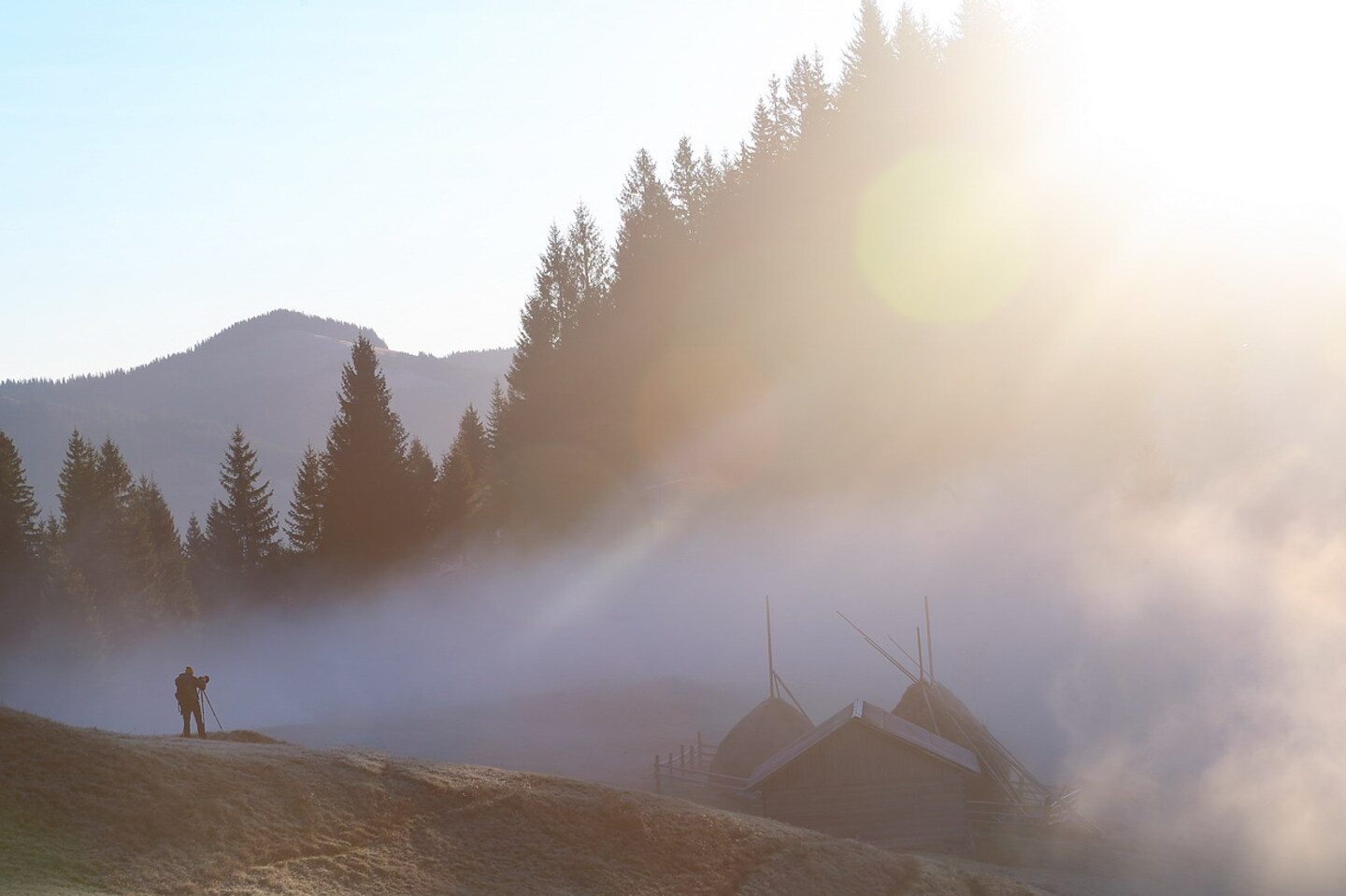
Dzembronya. Photo by Viacheslav Mishchenko
Content


