


 06.07.2024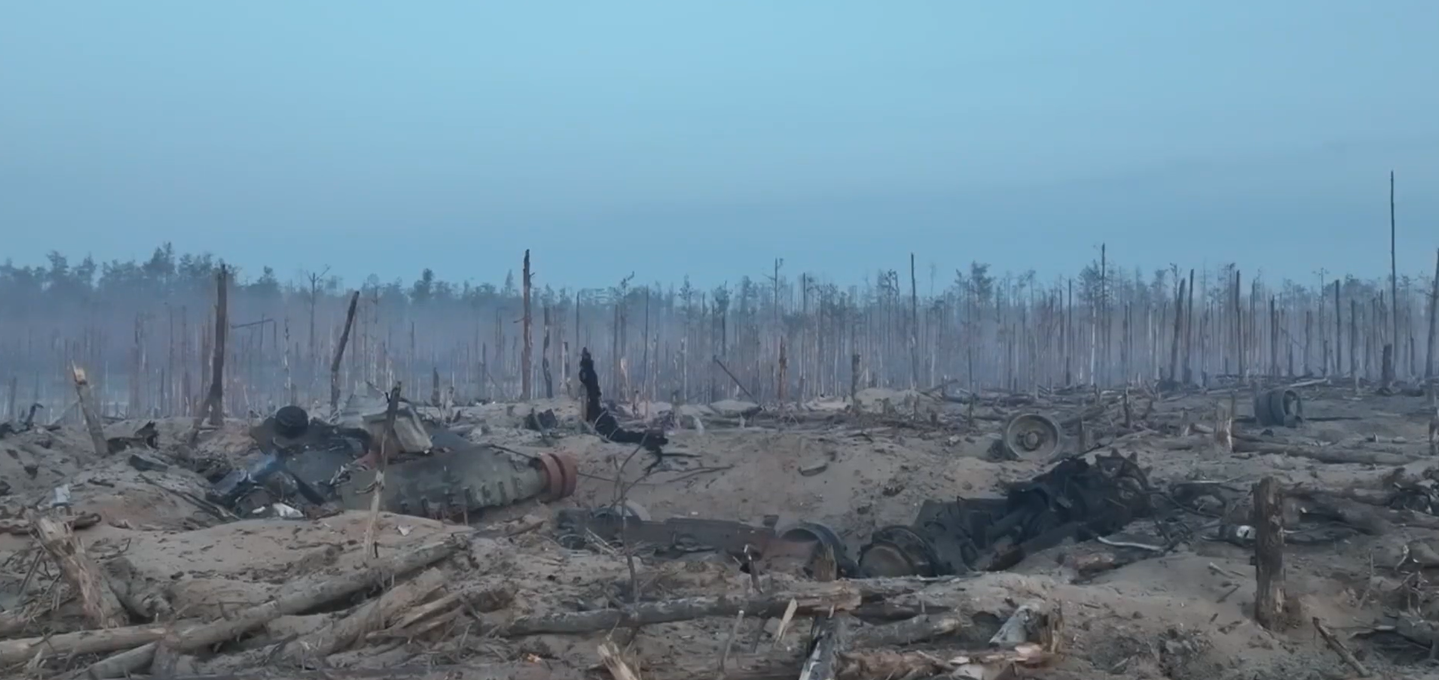
Since 2014, Ukrainian nature reserves have been turned into battlegrounds or ended up under military occupation. For example, russia seized the Kazantyp and Yalta reserves after occupying Crimea. The Holy Mountains National Nature Park, the Donetsk Ridge and Zuyivskyi landscape parks, and parts of the Luhansk Provallia Steppe Nature Reserve were damaged or completely destroyed during the fighting in the Donetsk and Luhansk regions.
With the start of russia’s full-scale invasion of Ukraine, reserves in the Zaporizhzhia and Kherson regions also came under occupation. The occupation authorities there are employing the practices already mastered in Crimea.
Within the framework of the #StopEcocideUkraine project, we discuss the ecocidal actions committed by russians on Ukraine’s occupied nature reserve lands.
THE GOAL IS TO SEIZE NATURAL WEALTH AND USE IT FOR FURTHER MILITARY AGGRESSION
russians exploit Ukraine’s protected areas wherever they can establish even a temporary foothold. They try to make this temporary presence permanent by legalizing their actions, at least within the framework of russian legislation.
Re-registration
After the occupation of Crimea, the russian state register saw an increase in legal entities, including national parks and reserves located on the Crimean peninsula. russians began re-registering them as property of their state. Thus, December 2014 saw the appearance of the Kazantyp Nature Reserve, the Tarkhankut National Nature Park, the Opuk Nature Reserve, and other “state budget institutions”.
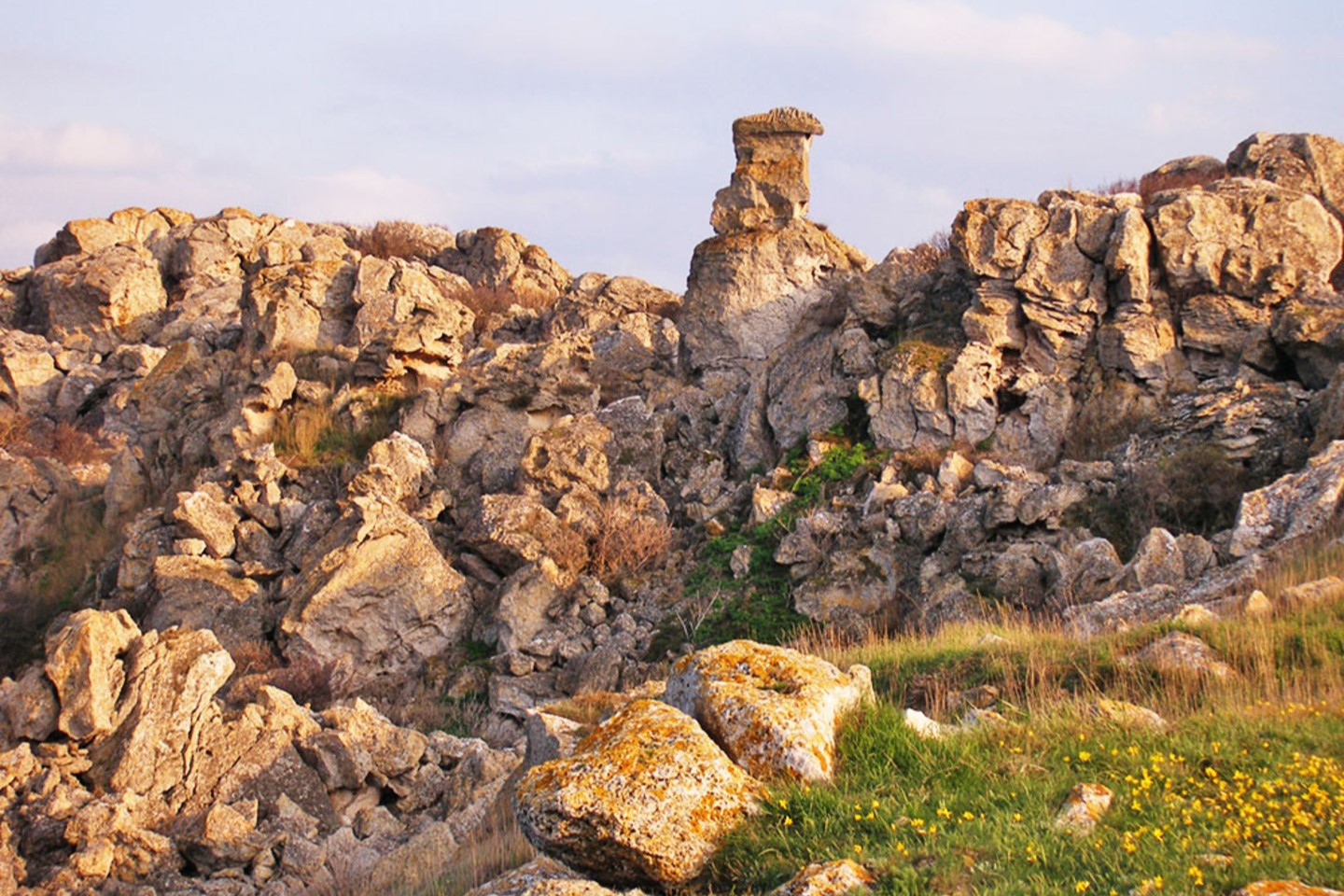
Kazantip Reserve before the russian occupation. Source: Encyclopedia of Modern Ukraine
However, from 2017 to 2023, the russian legal entities of the Kazantyp, Karadag, Opuk, Tarkhankut, and Karalar reserves were liquidated. No, the russians did not regret their conquest or acknowledge their crimes — they simply decided to centralize the management of protected areas through a single directorate, Zapovednyi Krym (Protected Crimea). This entity was created back in 2020, and its activities include fishing and logging. Thus, what is essentially a scheme with the creation of a parent organization legalized these operations on Ukrainian protected territories.
Another criminal activity concerning animals and a way of making money is carried out by the Karadag Nature Reserve in temporarily occupied Crimea. There, russians created a “science demonstration program” involving dolphins. Every day except Monday, visitors are treated to a “bright and colorful acquaintance with Black Sea bottlenose dolphins” — a rare species listed in Ukraine’s Red Book. Judging by the poster, an institution dedicated to studying and preserving nature instead entertains the public with shows similar to those at Nemo dolphinariums.
During the full-scale war, russians apply their experience of appropriation and destruction to mainland reserves under occupation. For instance, last year, the Ukrainian Dzharylhach National Nature Park (Dzharylhachsky in the russified version) was included in the russian unified state register of legal entities. According to this register, russians have allowed fishing and hunting, logging, and the extraction of clay, salt, oil, and natural gas on the territory of the national park. They also want to turn the protected area into a recreational zone by building hotels and restaurants.
In March 2023, russia also included the state-owned autonomous institution Askania-Nova Biosphere Reserve in its state register. The russians omitted an important part of the reserve’s name — the name of Friedrich von Falz-Fein, who founded it. The occupation administration of the Kherson Region appointed a former employee of the Security Service of Ukraine, Dmytro Meshcheriakov, as the reserve’s director. The National Police has already made him a collaborationism suspect for this.
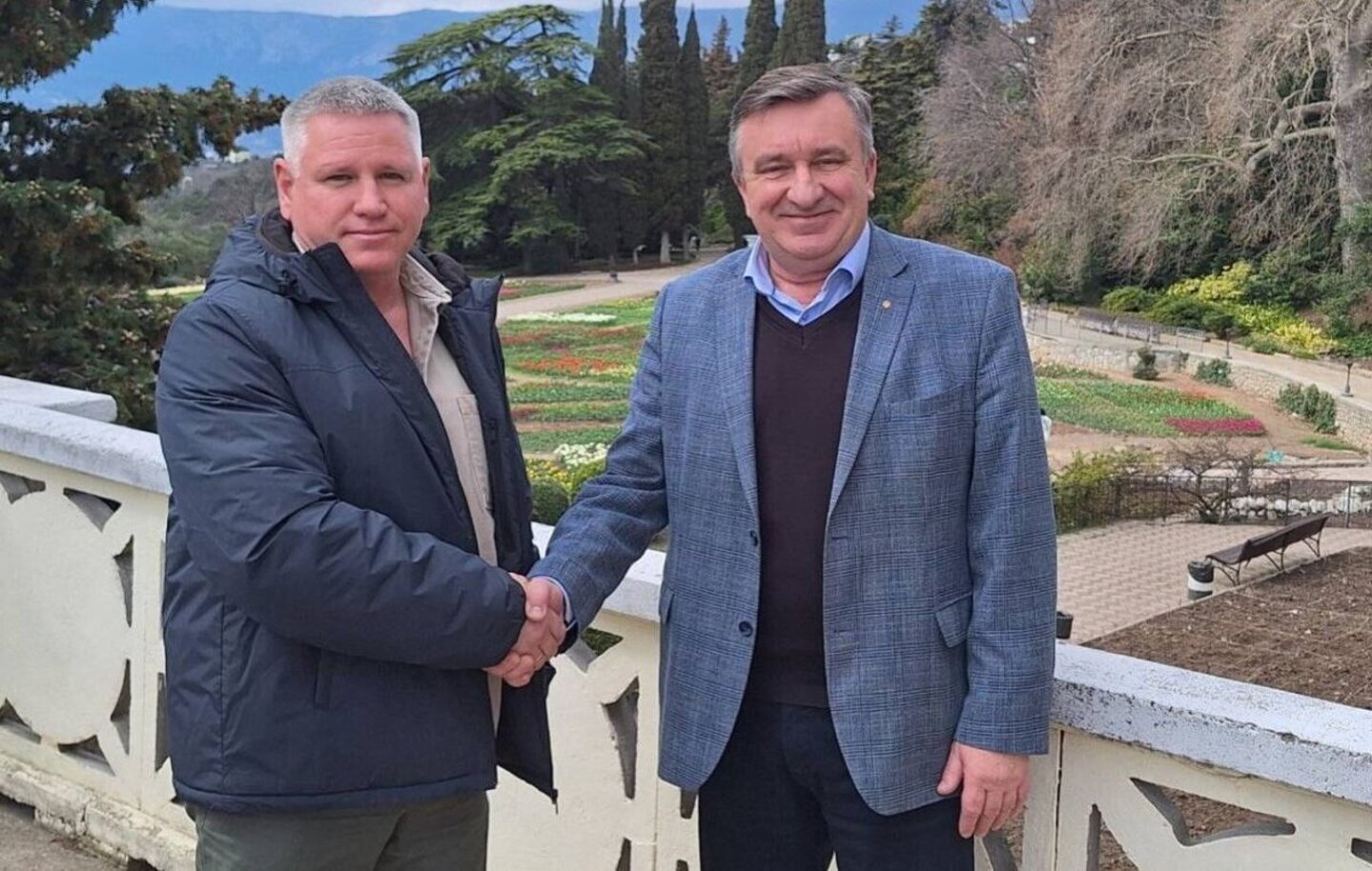
russian appointees to directorships: Dmytro Meshcheryakov (left) at Askania-Nova, Yuriy Pluhatar at the Nikitsky Botanical Garden
The same situation occurred in the Azov-Syvash National Nature Park in the Kherson Region. It was re-registered under russian law in February 2023, with Ukrainian citizen Yevheniy Popovchuk appointed as director. Evidently, he harbors political ambitions under the russian occupation regime, as he ran as a candidate from the United russia party in the illegal elections held in Kherson in 2023, becoming a deputy of the so-called Henichesk Municipal District of the Kherson Region.
Military Exploitation
However, re-registration and russian conservation status do not protect the occupied reserves: russians use these lands for military purposes, endangering and deliberately destroying them.
russians have set up a military training ground in the Pryazovskyi National Nature Park in the Zaporizhzhia Region. There, they conduct mortar fire drills, damaging the reserve landscapes with shelling. Last year, they also actively excavated the Molochna River to create a water barrier in case of a Ukrainian counteroffensive.
According to the Ukrainian Nature Conservation Group, at the beginning of the full-scale war, russians also entrenched themselves in the south of the Donetsk Region, in the Meotyda National Nature Park. This destroyed the nesting sites of wetland birds: the Pallas’s gull, oystercatcher, Dalmatian pelican, and Sandwich tern. Ornithologist Vadym Zhulenko explained that these birds nest only in that location.
The consequences of the occupation of protected areas can already be assessed by the condition of those that have been liberated. For example, after the de-occupation of the Kamianska Sich National Nature Park in the Kherson Region, experts discovered the barbaric method russians used to camouflage their military positions. The invaders tore up rare feather grass species and other plants, which the park was created to protect.
Moreover, let us also take a closer look at the Holy Mountains National Nature Park in the Donetsk Region, which was under occupation from February to autumn 2022. According to its director, Serhiy Pryimachuk, during these months, russians destroyed about 5,000 hectares of forest and removed equipment belonging to the park. The protected area was heavily mined, and mine explosions continue to cause fires.

A similar story unfolded in Dvorichansky National Nature Park, occupied in spring 2022. When the Ukrainian Armed Forces liberated the Kharkiv Region in the autumn, russians had mined the park area, including with anti-personnel mines known as “petals” [PFM-1 anti-personnel land mine]. Demining is not possible at the moment — it can only be done after the fighting is over. The park is too close to the russian border.
METHODS — BURNING PLANTS, STEALING AND SHOOTING ANIMALS
Regional military administrations monitor the condition of occupied biosphere reserves and national nature parks using satellite imagery and maintaining contact with employees who were forced to remain under occupation. They report that these territories suffer most from fires: forests and steppe grasses burn. Consequently, animals suffer from starvation as well as die from mines and shelling. They also get killed by russian poachers and stolen from Ukrainian reserves to russian zoos.
Nature in Flames
According to the Kherson Regional Military Administration, over 5.5 thousand hectares of the Askania-Nova reserve have burned since February 24, 2022—almost one-fifth of its territory. Agricultural landscapes were most affected: arable land, fallow fields, and shelterbelts. The administration explains this by neglect: weeds have grown, which quickly dry out and are susceptible to catching fire.
However, protected zones also suffered from fires, including the “model” fescue-feather-grass steppe of the Black Sea region, the main ecological asset of Askania-Nova. The most significant damage was caused by large fires on August 22 and September 1, 2023. Plants listed in the The Green Data Book of Ukraine is a government document that promotes the protection of entire plant groups.Green Data Book of Ukraine (2009), primarily Ukrainian feather grass [Stipa ucrainica] and downy feather grass [Stipa capillata], were burned. Additionally, during the firefighting on September 1, 2023, russians plowed the virgin steppe in the reserve, damaging the soil.
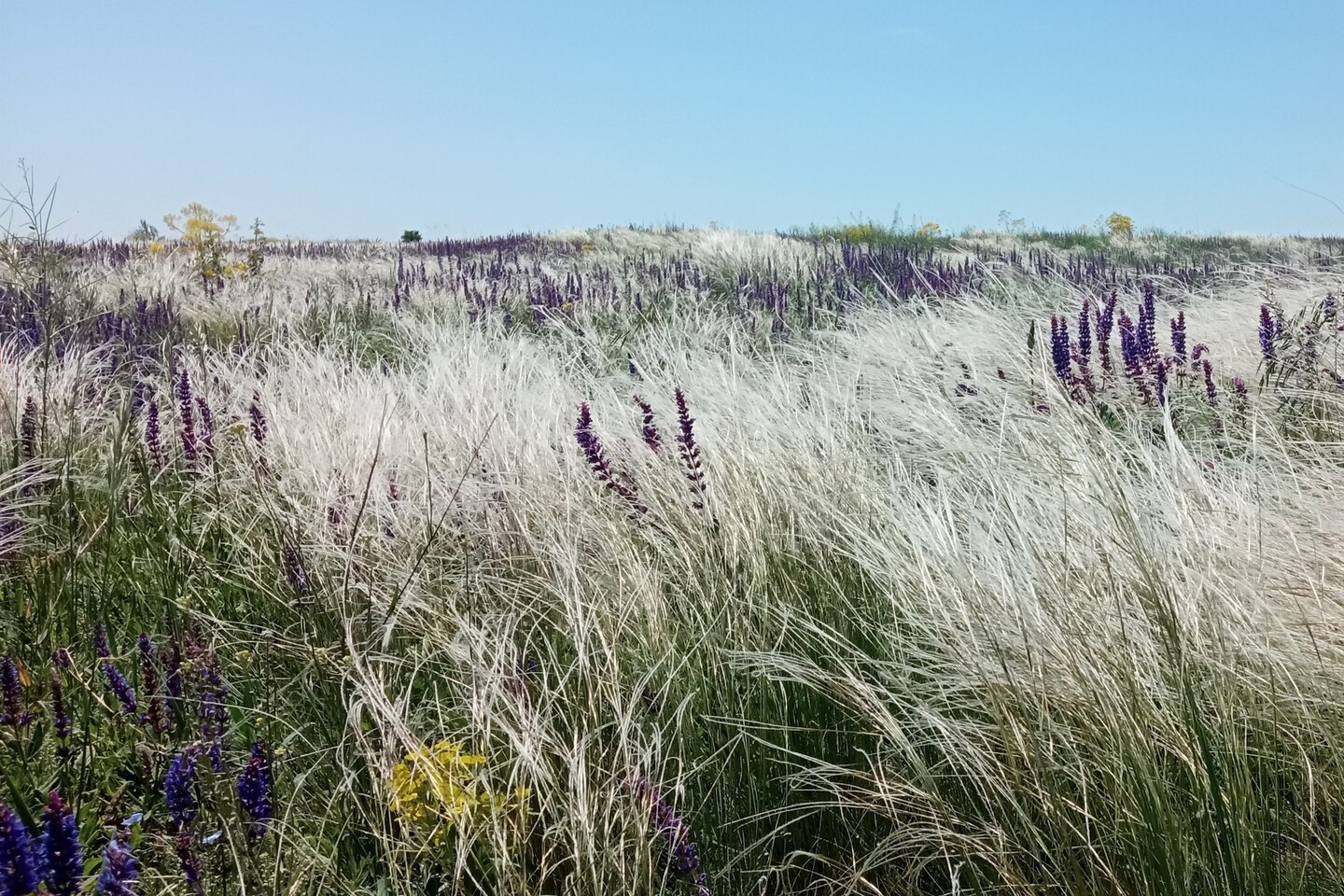
A plot of “model” steppe. Source: Facebook page of Askania-Nova
Partially affected by the fires was the bottom of the Great Chapelsky Hollow [also referred to as the Great Chapelsky Lowland], a wetland of international importance protected by the Ramsar Convention. The entire reserve area is part of Ukraine's Emerald Network is a network of areas of special conservation interest that is part of the Emerald Network of Europe.Ukraine’s Emerald Network.
In 2023, the Dzharylhach National Nature Park experienced 36 fires which burned over 1.5 thousand hectares of protected land. Rare Red Data Book orchids, sawgrass, and other valuable plants used to grow there. Deer, fallow deer, foxes, and gray hares had to flee the fires. The damage to the park is estimated at over 102 billion hryvnias [~2.5 billion US dollars].
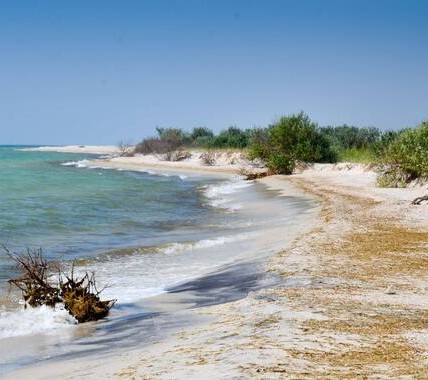
Dzharylhach before the russian occupation
Source: Nature Reserve Fund of Ukraine
Photo by Volodymyr Tolstykh
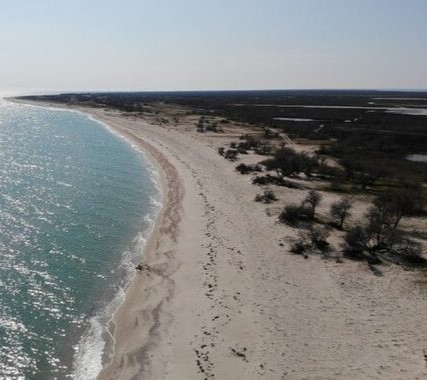
Dzharylhach in August, 2023.Source: Dzharylhach National Nature Park
From February 2022 to April 2023, over 7 thousand hectares of protected lands in the Lower Dnipro National Nature Park burned. In June, when russia blew up the dam of the Kakhovka Hydroelectric Power Station, the park was completely flooded. The damage to the plants cannot be determined since most of the park’s territory remains under military occupation.
In the Mykolaiv Region, the Kinburn Spit, located in the Ivory Coast of Sviatoslav National Nature Park, regularly suffers from fires due to russian military actions. Over the two years of full-scale war, park employees recorded more than 200 fires on the occupied territory. The fire often reignites in the same area, affecting over 6 thousand hectares of the reserve.
The Luhansk Regional Military Administration reported that eight forest fire sites caused by active hostilities in the region have been identified since 2022. These fires have damaged parts of the Kreminna Forests National Nature Park and the Triokhizbenskyi Steppe Reserve branch of the Luhansk Nature Reserve.
After de-occupation, the Holy Mountains National Nature Park in the Donetsk Region still suffers from russian shelling. Constant fires from attacks prevent the forest from recovering. The fires also cause significant damage: on May 7, 2024, over 470 hectares of forest burned, with the State Environmental Inspection estimating the damage at over 2.6 billion hryvnias. This assessment had to be conducted remotely, relying on firefighter reports and geospatial data, as the park’s territory is mined.
Explosives pollute the soil, hindering plant growth and generally negatively impacting flora restoration. “I know from 2014 — when Grads [MLRS] shelled a plot of land in the forestry — that for 8 years, not even grass grew there,” says Serhiy Pryimachuk, director of the Holy Mountains Park, about the war’s consequences for nature.
Animal Deaths and Injuries
On Ukrainian conservation lands under occupation, animals die due to inadequate care and suffer injuries and stress due to hostilities.
Viktor Shapoval, director of Askania-Nova, reports that many animals in the reserve die from a lack of proper care. For instance, in November 2023, three Cape buffaloes, warmth-loving African animals, died on the territory of the Great Chapelsky Hollow because the occupation administration did not move them to winter quarters in time. Another female buffalo died on the way there.

Cape buffalo. Source: Facebook page of the Environmental Information Center of the Oles Honchar Kherson Regional Universal Scientific Library
The Kherson Regional Military Administration estimates the losses to the Askania-Nova reserve from animal deaths and removals at 970 thousand hryvnias [~24,000 US dollars]. This is not the final amount, as the damage continues to be calculated, however, it won’t bring the animals back.
In the occupied part of Zaporizhzhia Oblast, in the Pryazovskyi National Nature Park, russian invaders and local collaborationists engage in fish poaching. According to the park’s director, Dmytro Volovyk, they have placed at least 8 kilometers of fishing nets in the Molochnyi Estuary Hydrological Reserve, collecting up to 5 tons of fish daily.
He also confirms that in the Azov-Syvash National Nature Park, the invaders kill animals “for meat”, “Animals from Biryuchyi [Island] are shot and transported in trucks. I know of an incident where the invaders shot a truckful of hooved animals, with blood dripping from the car trunk.”
There are also reports from occupied parts of the Kherson Region that russian soldiers hunt there. The animal killers do not hide their actions and post photos of their prey on social media. Zoologist Vitaliy Smahol identified a male red deer in these photos. Before the war, herds of these deer used to live in the Askania-Nova reserve and the Azov-Syvash National Nature Park.
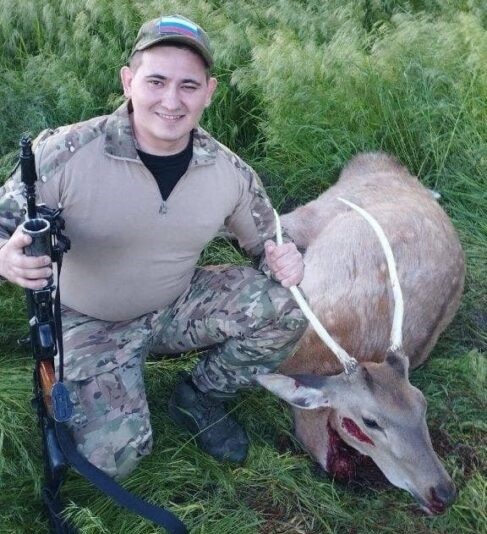

Theft of Red Data Book Animals
russians illegally transport animals from Askania-Nova, disguising their actions with a “cooperation agreement,” but these documents are signed not by the legitimate Ukrainian director but by the russian appointee.
In 2023, the National Resistance Center reported that russians were taking animals to the Safari-Park in Krasnodar. The park has a petting zoo, and the animals are kept in enclosures, which are very different conditions from Askania-Nova, where the animals roamed freely.
In December of the same year, the russians illegally exchanged several specimens of Chapman’s zebra, American bison, Przewalski’s horse, and Père David’s deer from Askania-Nova for eland antelopes, domestic yaks, and Bactrian camels from the Rostov Nature Reserve. The species taken from Ukrainian territories are listed in the Red Book and included in the International Union for Conservation of Nature’s Red List with statuses such as Extinct in the Wild, Critically Endangered, and Near Threatened.
russian propaganda media also report “exchanges” between Askania-Nova and the Tayhan Park in Crimea. In the spring, a 15-year-old pregnant Chapman’s zebra and two foals of this species were taken from Ukraine to Crimea. In return, pelicans, dwarf pigs, alpacas, and a Eurasian bustard were taken from the park in the occupied Crimea. Tayhan has a bad reputation even in russia: its director Oleg Zubkov is often accused of animal abuse. He himself states that he has gone through 582 court sessions involving 70 administrative and six criminal cases. Animal rights activists say he is protected by the occupation authorities of the peninsula. They also sent a petition to vladimir putin, citing the Tayhan Park as “a parody of a zoo, an amateur zoo garden without any animal professionals, with daily dangerous situations caused by the reckless actions of the park owner Zubkov.”
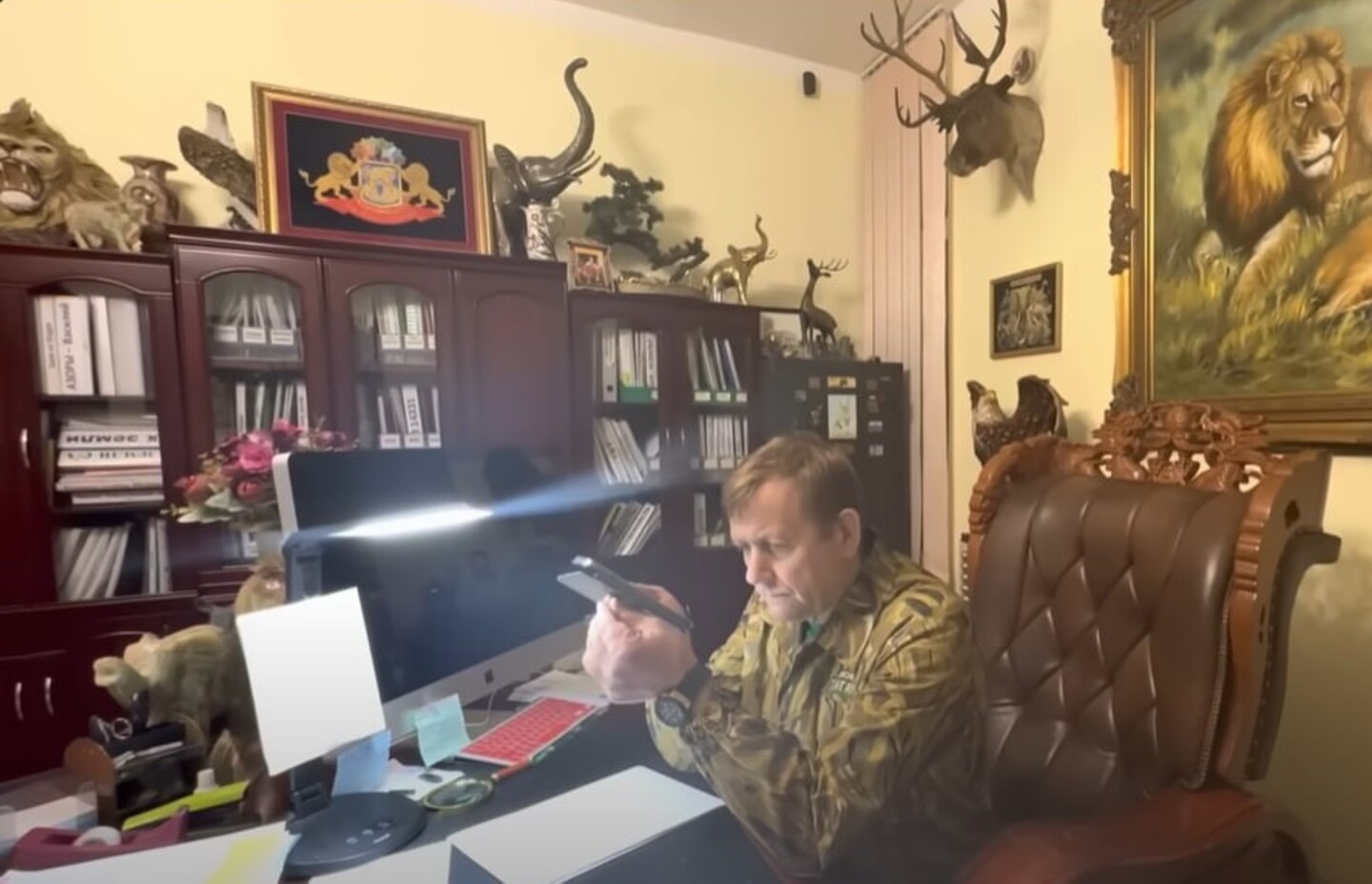
Oleg Zubkov, thief of animals from Askania-Nova. Screenshot from a video on his YouTube channel
Moreover, the same Oleg Zubkov owns another animal abuse facility—the Skazka Zoo. russian Red Data Book animals — Bengal tiger cubs — have already died there. Now, the zoo has signed a criminal agreement with the occupation management of Askania-Nova to obtain Ukrainian Red Data Book animals.
By managing temporarily occupied Ukrainian reserves, russia exploits loopholes in international law. For instance, the Rome Statute still lacks a definition of ecocide as a crime, and the Geneva Convention does not specifically protect reserves and sanctuaries. While there is a 2016 UN General Assembly resolution on the environment that calls on member states to protect the environment during armed conflicts, UN resolutions are not binding, and thus russia has not included environmental protection requirements in its military documents.
Therefore, Ukraine must vigorously advocate for changes in international law that would hold russia accountable for the damage to Ukrainian protected territories and the environment in general.
THANK YOU FOR CARING ABOUT NATURE UNDER OCCUPATION!
Please share this investigation on your social media. We also appreciate any support for our editorial team, enabling us to continue telling these essential stories for those who cannot speak for themselves.
Cover photo: Kreminna Forests, 2024. Source: Open Forest NGO
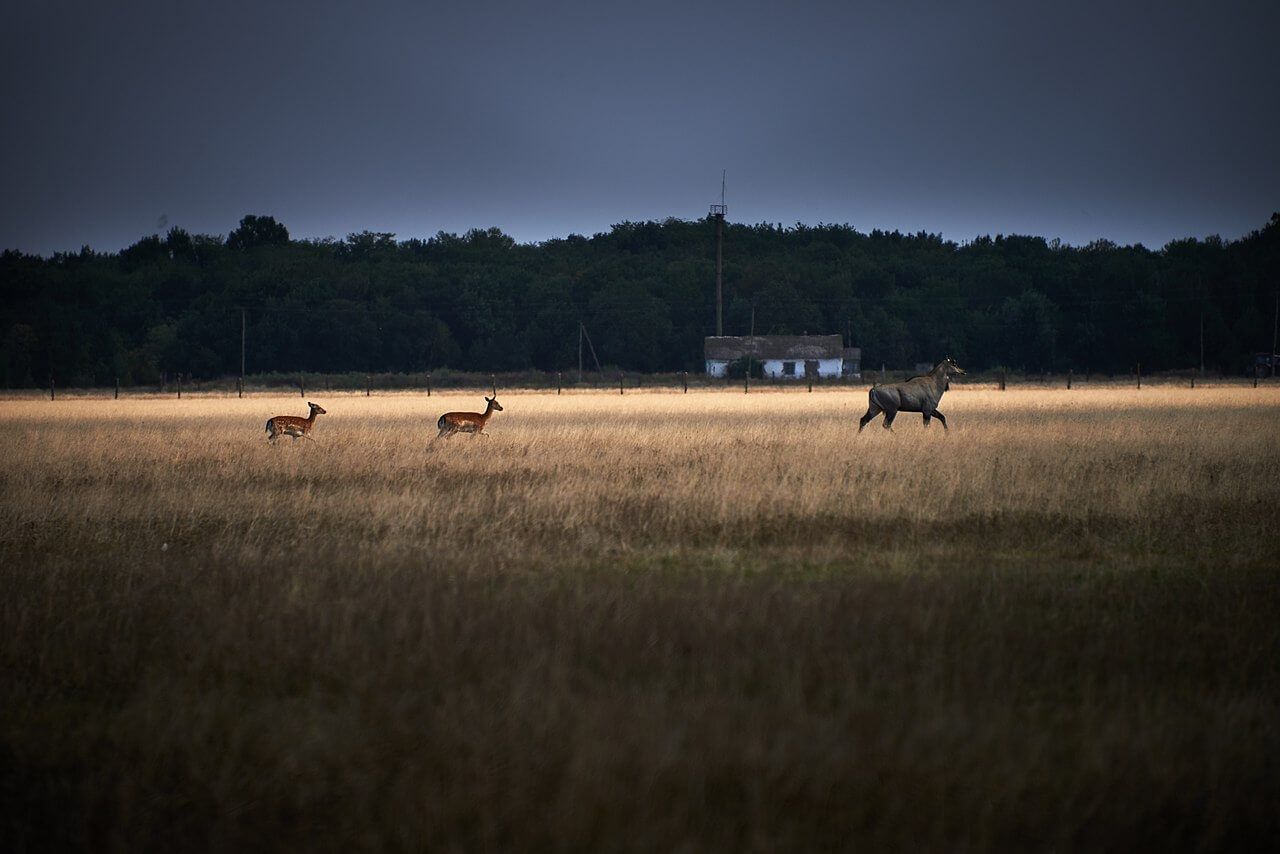
Bottom banner photo by Roksolana Baran. Source: Nature Reserve Fund of Ukraine


This publication was compiled with the support of the European Union and the International Renaissance Foundation within the framework «European Renaissance of Ukraine» project. Its content is the exclusive responsibility of the authors and does not necessarily reflect the views of the European Union and the International Renaissance Foundation.
Content


