



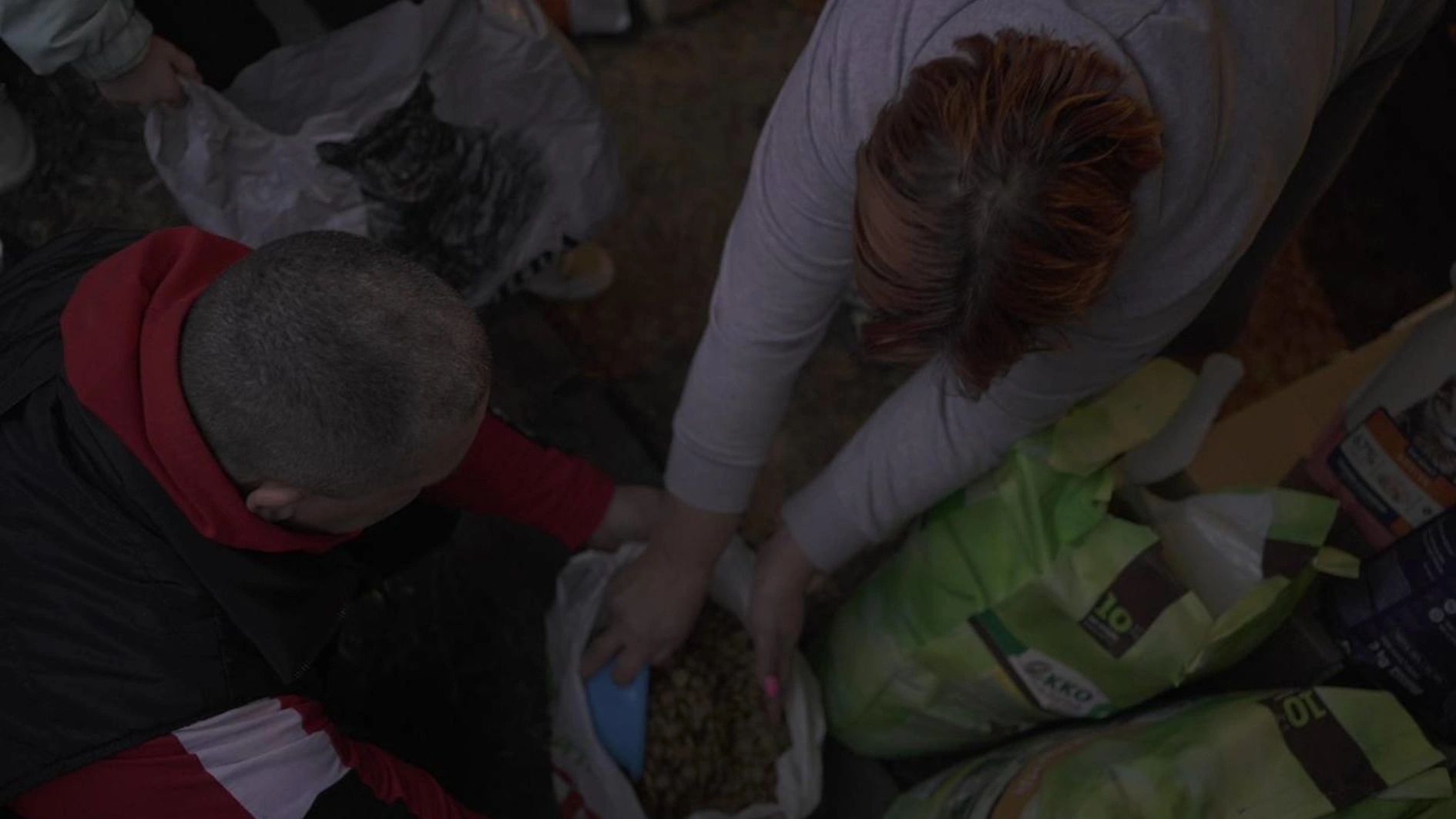
Throughout September, October, and November, UAnimals continued to deliver food and preventive treatments to frontline communities, where people often cannot afford to buy basic supplies for animals due to the fighting and lack of logistics.
Over three months, community volunteers and the UAnimals evacuation team conducted more than 20 distributions and delivered aid to more than 40 settlements in the Donetsk, Kharkiv, Sumy, Dnipropetrovsk, Zaporizhzhia, Mykolaiv, and Kherson regions. Some of these locations are only 5–7 kilometers from the front line.
If you want to join in the support, make a one-time donation or sign up for a monthly donation to regularly support animal rescue.
How much aid was delivered?
During the fall, we delivered:
- 4,710 kilograms of cat and dog food;
- 1,272 antiparasitic treatments.
This helped more than 2,200 animals.
Where and who did we help?
Volunteers visited frontline communities where people took in abandoned and injured cats and dogs. In many villages and towns, residents took responsibility for dozens of animals.
According to volunteers, each yard currently has an average of five dogs and five to eight cats that were left without care after active fighting and evacuations. There were yards where volunteers counted more than 10 dogs and cats.
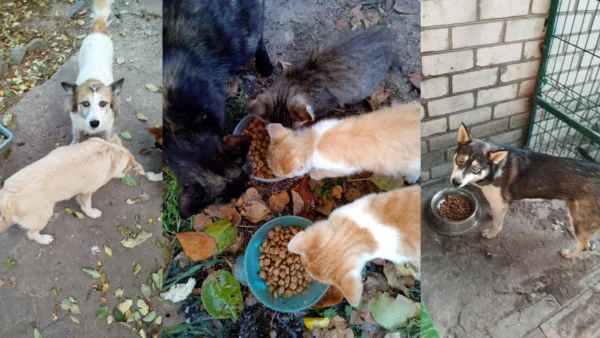
Among the settlements to which food and supplies were delivered are:
- Orikhiv, Primorske, Tavriiske, Zarichne, Yurkivka, Komyshuvakha (Zaporizhzhia region);
- Pisochyn, Bratenitsa, Ivano-Shyichyne, Solonitsivka, Utkivka, Lyaluki, Karavan, Sanzhary, Barchan, Vodyane, Korotych, Vilshany (Kharkiv region);
- Dobropillia, Druzhkivka, Sloviansk, Novovodyane, Bilozerske, Myrove, Vesele Pole, Samiilivka, Krynychky, Sviatohirivka (Donetsk region);
- Kotlyarove, Shevchenkove, Dmytrivka, Kutsurub (Mykolaiv region);
- Mirne, Kherson, Tekstilny, Chornobaivka (Kherson region);
- Pavlohrad (Dnipropetrovsk region);
- Seredina-Buda, Yampil, Svesa, Khutir-Mykhailivskyi, Zno-Novgorodskyi, Chuikivka (Sumy region).
Due to the threat of shelling, several points on the routes had to be canceled, in particular, the distribution in Kozacha Lopan, where, according to the military, the situation was “too hot.”
Some of these distributions were made possible thanks to the support of Abri voor Dieren, a Dutch animal welfare foundation that provided UAnimals with a grant to purchase food and treatments.
Stories of people who continue to care for animals in the frontline
“Our city is on the frontline, it’s almost impossible to buy food.”
Ms. Tetyana was supposed to evacuate in November, but at the last moment she was denied housing because of her animals. Now she remains in Sloviansk with her neighbors — pensioners and a girl with a disability. Together, they have taken in dozens of animals.
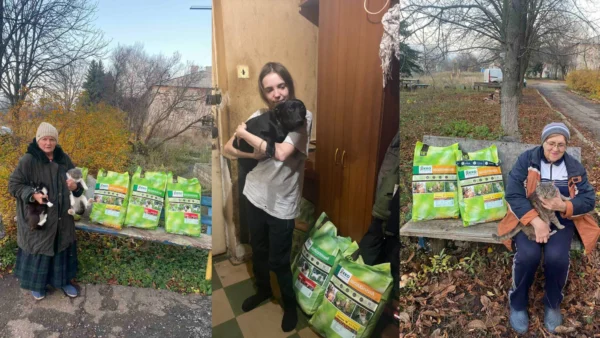
“I want to thank the UAnimals team for providing our community with food and parasite treatments. We live in the frontline city of Sloviansk, and it is very difficult for us to buy food for animals. I asked UAnimals for help, and the manager, Ms. Oleksandra, responded immediately and sent the amount of food and treatment we requested. We are sincerely grateful for such help. Two days later, they sent a large amount of food and treatment for the animals. We are very happy and grateful to the manager and the organizers of the aid. It is very difficult for us to buy food,” Ms. Tetyana wrote to us in the end, even though she periodically lost contact due to severe power outages and shelling in the city.
“She is blind. She has 10 dogs and 8 cats.”
In one of the communities in the Mykolaiv region, volunteer Natalia Korneeva met a blind elderly woman. She takes care of 10 dogs and 8 cats. The woman cannot leave her home, so a caregiver comes to her. All the animals were rescued from the streets or abandoned by neighbors during the evacuation. Food for them is always a problem.
“Everyone is just waiting for everything to burn down and die out.”
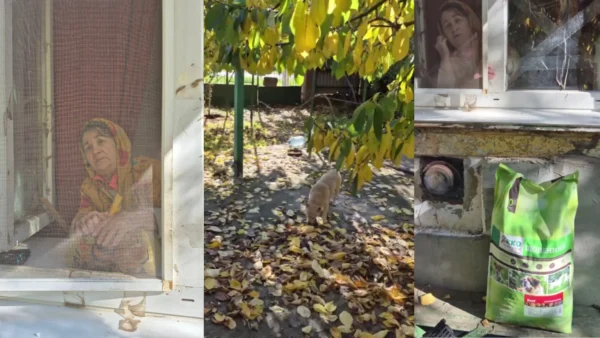
Another volunteer, Natalia Karas, who delivered aid to several settlements in the Sumy region, shared that people are very grateful for the help. After all, almost nothing works there, people have no access to government institutions, post offices, transport, or even the police.
“On the other side of the 30 km zone, everyone is just waiting for everything to burn down and die. But we hope that it will all end soon and we will save and rebuild what remains. To distract ourselves somehow, we help those we can,” say the locals.
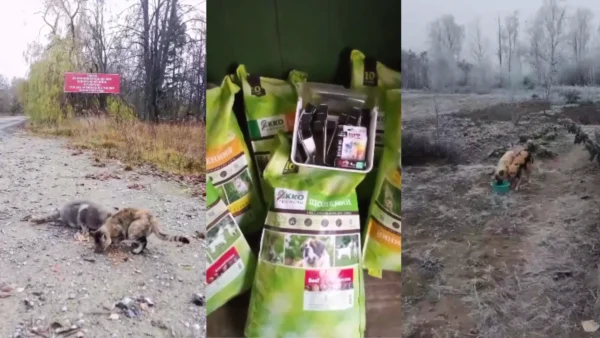
Here, in the Sumy region, they also left parasite treatment for a dog named Zhorik, whose story is both horrifying and touching. The military took him in when he was still a puppy. For some time, he lived with them right on the front lines. Unfortunately, the Russians bombed their location with a KAB, and Zhorik was buried under the rubble. The military returned to their positions three days later, wanting to dig up and bury the dog, but it turned out that he was alive. They took Zhorik with them to a new location 10 kilometers away, but he returned. Now he is being cared for by Dmytro, who told his story.
Why is this support important?
In frontline areas, people often live without:
- stable income,
- access to regular and veterinary hospitals,
- shops,
- under shelling.
And yet they take care of dozens of animals that have been left behind in half-destroyed towns and villages. Food and treatment are the bare minimum that gives hope that these animals will not go hungry or get sick.
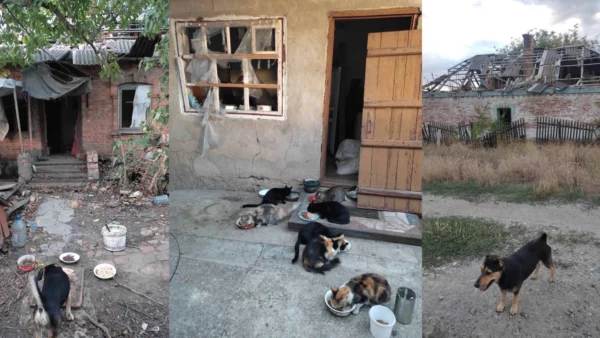
Thanks to the UAnimals community, this fall, animals in dozens of frontline settlements received food and necessary care. And people received support and the feeling that they were not alone.
How to get involved?
Thousands of animals in frontline territories still depend on human help. If you want to help: Support UAnimals with a donation — these contributions allow us to purchase food, medicine, and supplies for new distributions.
Together we can do more — and thanks to you, thousands of animals have already received help this fall.


