



 18.10.2024
Militaries worldwide emit greenhouse gases that accelerate global warming. russia, with all its emissions caused by war, is accelerating the process even more. Meanwhile, we are no more than four years away from a 1.5°C rise in the global average annual temperature relative to pre-industrial levels.
Can anything still be done?
Olha Chevhaniuk, Head of Strategic Initiatives at UAnimals, talked about this with Lennard de Klerk live on air. We share the highlights of this conversation.
A Little Green Capitalist
I grew up in a Dutch village with three older brothers. All of us brothers had several nicknames. One of my nicknames was Green Capitalist. Capitalist — because I didn’t mind making money, Green came because I was always concerned about the environment and cleaning up our mess.
My father had a factory. He produced packaging material for flowers, which is very fitting for the Netherlands. As a child during summers, I worked in the factory, and because of that, I became interested in the environment. You know, see all the plastic, you have waste materials… I was often working with a small recycling machine, trying to reuse the plastic materials. It was already a circular economy in the early days.
I started my studies in the early nineties when the Soviet Union fell apart. I realized that we in the West had no clue about what we called the East block, about all these different countries and nations. My parents had a satellite dish and I was playing a lot with it. I managed to get all these TV channels from Hungary, Romania, and the Baltic states. I got sort of interested in the part of Europe I knew nothing about. So, I started working in an engineering and consulting firm, which had its biggest office in Kyiv.
I knew nothing about Ukraine. I’m ashamed to say it now, but like many of us, I thought it was “sort of russia, but a little bit different.” I lived there for several years, traveled around the country, and learned about its regions and proud history, and I fell a little bit in love with the country. It was 1999-2001 — these were difficult times for Ukraine. The murder of the journalist Georgiy Gongadze happened, Leonid Kuchma was a president, so it was not always going in the right direction, but you could see a country developing so much differently from russia.
To cut a long story short, when I got back to the Netherlands, I started working for the Dutch government and got involved in climate change, helping to reduce emissions of greenhouse gases.

Lennard de Klerk on the Military Emission Gap Conference 2023, 26 September 2023, Oxford
What brought you to research the impact of the war on climate change?
I live in Hungary and run a climate-neutral resort there. When the full-scale invasion started, we were able to house many Ukrainians who were on their way to Europe so that they could recover from the week in a car. I thought, what can I do besides helping refugees?
Since climate change is my expertise, I started thinking about what russian aggression does to the climate. When I started to work on this topic, I told friends and colleagues, and we realized that this was never done before — to look at the impact of conflict on climate.
The impact of this war is mostly on Ukraine’s territory. However, it also increases greenhouse gas emissions and accelerates global warming. I believe that by telling this story, we will also be able to show that russian aggression impacts the world.
A Reminder about Climate Change
Climate change is caused by the emission of so-called greenhouse gases. Carbon dioxide is the most common greenhouse gas, but we have other gases besides CO2: methane, nitrous oxide, halogenated other gases. There are also gases such as sulphur dioxide, ammonia and black carbon aerosols. They all accumulate in the atmosphere. As a result, they trap the heat of the sun. That is why the average temperature in the world is going up.
In the UN’s Paris Agreement, we agreed to limit this increase in temperature to 1.5°C above pre-industrial levels. We cannot stop climate change anymore, it’s too late. But if we limit it to 1.5 degrees above pre-industrial levels, it is more or less manageable.
If we get to 2 degrees or more, we will not be able to manage it anymore: catastrophic weather events can occur. We will have people on the move, etc.
We only have 4 years left before the amount of greenhouse gases accumulated in the atmosphere is already enough to raise temperatures by 1.5 degrees.
So, we really have to work very hard to reduce greenhouse gas emissions drastically. But russia, with this war, is doing the opposite — it is causing more emissions. It is basically accelerating the growth of temperature and, therefore, the impact of climate change.

War in Ukraine and Greenhouse Gases — What’s in Common?
What are the key environmental consequences of this war?
We concluded that the total emissions caused by the war were 175 tons of CO2.
- It is the same as the Netherlands, with 18 million inhabitants emits in a year. The Netherlands is a highly industrialized country.
- It is the same as putting 90 million new petrol cars on the road.
- Or building 260 coal-fired power plant units of 200 MW each.
It is significant.
Of course, if you look at the total picture of the world’s emissions, it is relatively small. But again — you should understand that we should bring the emissions down, they should ultimately reach zero. But the war is pushing emissions in the opposite direction.

How much of an impact do the burning russian oil depots have on climate?
We looked at different categories of emissions, including energy infrastructure — all the emissions caused by the damage done to power stations. That includes the emissions from oil depots that are put burning not only in russia, but also the oil depots that russians have destroyed in Ukraine. The total impact of energy infrastructure is 10%. But if we look at burning deposits, it’s relatively small. It’s below 1% of the total.
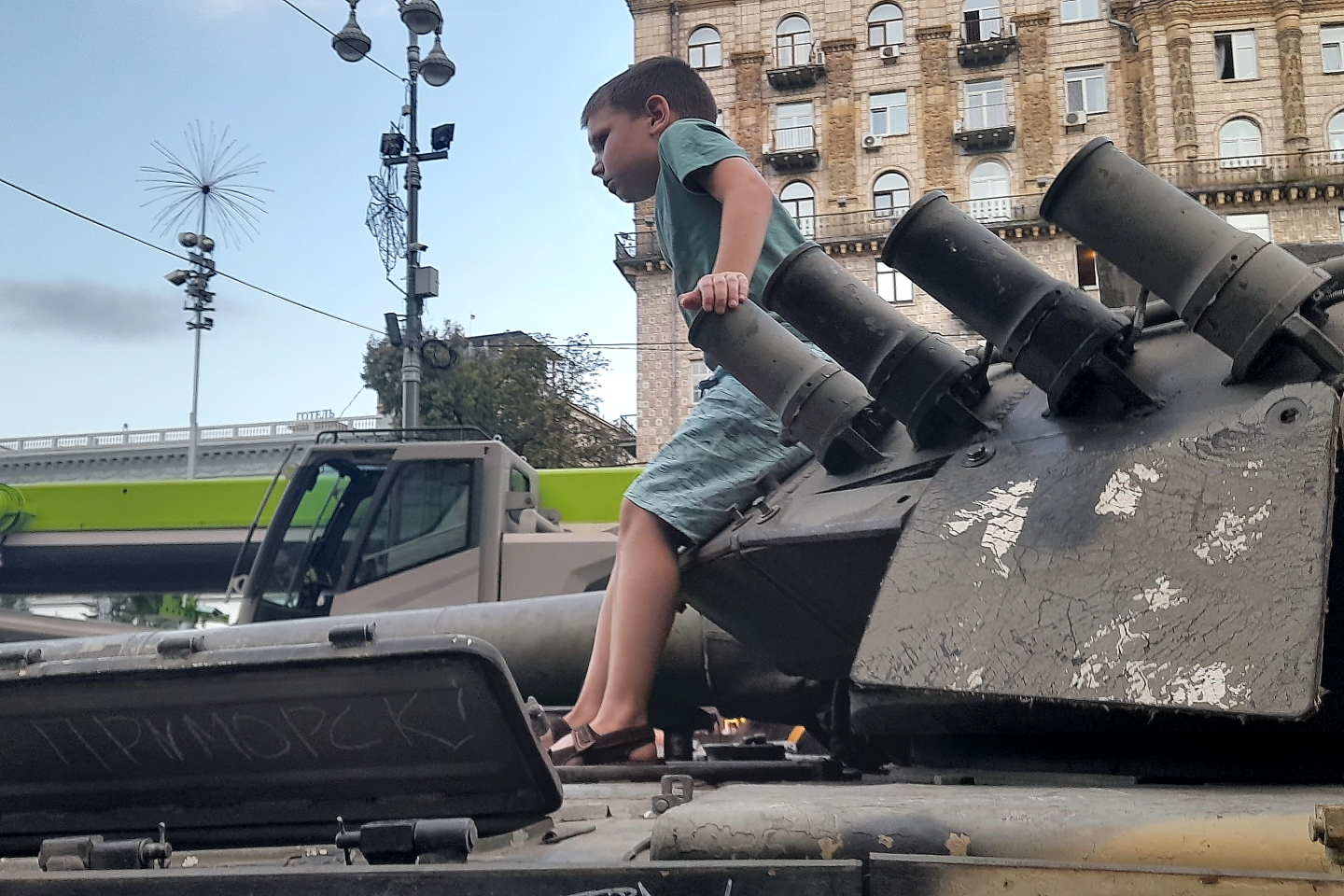
More important is the direct use of the military. All these tanks, all these vehicles use enormous amounts of diesel and kerosene. And that causes tremendous amounts of emissions.
Are more emissions generated in russia since they are at war, increasing manufacturing and energy use?
Yes, in particular in the production of military equipment. They use a lot of steel, and steel is a very carbon-intensive material. We haven’t seen the numbers yet. Every country must report their emission numbers to the UN with a 2-year delay, and russia hasn’t published its report for 2022. But I do expect an increase there.
Where does russia rank in terms of emissions on a global scale?
The first one is China, second is the USA. russia is ranked fifth.
Ukraine is much lower, simply because it’s a smaller country.
If the war doesn’t stop, what changes will we have?
Climate change will continue. It might very well be that these extra emissions caused by russia will not impact Ukraine but will cause flooding in Bangladesh or fire in the Amazon. It’s a global phenomenon. You cannot distinguish who caused what. This is just contributing to the buildup of greenhouse gases.
The Indirect Impact
Do you feel your studies influence decision-making?
It’s an eye-opener. As it was an eye-opener for me to see that conflict does so much to climate.
Militaries all around the world emit much CO2, even if there’s no war. Military emissions are about 5% of the world’s total. They train, they practice using military transport…
russian aggression made all Europe realize that we are not safe—therefore, we have to invest more in defense. Many countries in Europe are increasing military spending and investing more in military equipment. That means military emissions will also go up. With a delay, it will increase emissions worldwide.
I fully understand that climate change is not the biggest problem for Ukraine now. You are fighting to survive as a nation. This story doesn’t hit the headlines in Ukraine; I think it’s normal.
But what you see in Europe, militaries like NATO realize that they contribute a lot to climate change. One of my latest conferences was in June in Oslo, about European defense, where several militaries came together to discuss how they can reduce the environmental impact of what they do. Climate change was one of the main topics. They agree to start working on decarbonization, reducing emissions. So it is getting there.
Another interesting impact of wars is that the war also changed supply lines in the world.
russia closed its airspace above Siberia for Western airplanes. If you fly from London to Tokio, it normally takes 11 hours, but now airlines take completely different routes over Canada, which makes the flight 4 hours longer, meaning more kerosine, more CO2 emissions. We are working on getting more precise numbers of the impact on aviation.
It has parallels with conflicts around the world. For example, houthis are attacking ships in the Red Sea. A lot of marine transport is avoiding the Red Sea; it has to detour Africa, meaning more diesel and more emissions.
After the War
What impact are you expecting from your studies?
The most significant impact would be to hold the russian federation accountable for those emissions. That is a long shot. The legal system works slowly, and it would be particularly for this case. There is no precedent. It will definitely take years. But when it happens, it will show to the world that anyone will be responsible in case of this part of aggression — environmental crime.
A study published in Nature describes the total damage caused by every ton of CO2 emitted to the atmosphere: 185 US dollars. If we consider 175 million tons of CO2, we are talking about damage of almost 33 billion US dollars. This damage will happen somewhere in the world. We don’t know when or where, but it will happen.
That is the compensation we are anticipating from russia.
The idea is that part of the money goes to Ukraine to recover, for example, by replanting the forests that went up on fire because of the shelling. Also, for the reconstruction of buildings, by using less fossil fuels, less steel, but more climate-friendly materials.
The other part should go to the Global South — the developing countries impacted by climate change to improve water management, for example.
You in Ukraine have such a strong civil society. Once this horrible war is over, reconstruction will be done in a way that is thought-through.
Civil society organizations should be very loud to the government about how to work on it. There will be a lot of money coming from the West to help Ukraine recover, but it is your role as a civil society to make sure this money is well spent.
It will not be easy, but I’m confident you will do it right in a sustainable way. You are tough cookies.


This publication was compiled with the support of the European Union and the International Renaissance Foundation within the framework «European Renaissance of Ukraine» project. Its content is the exclusive responsibility of the authors and does not necessarily reflect the views of the European Union and the International Renaissance Foundation.
Main image: Lennard de Klerk. Source: Ministry of Ministry of Environmental Protection and Natural Resources of Ukraine
Content


