



 30.05.2024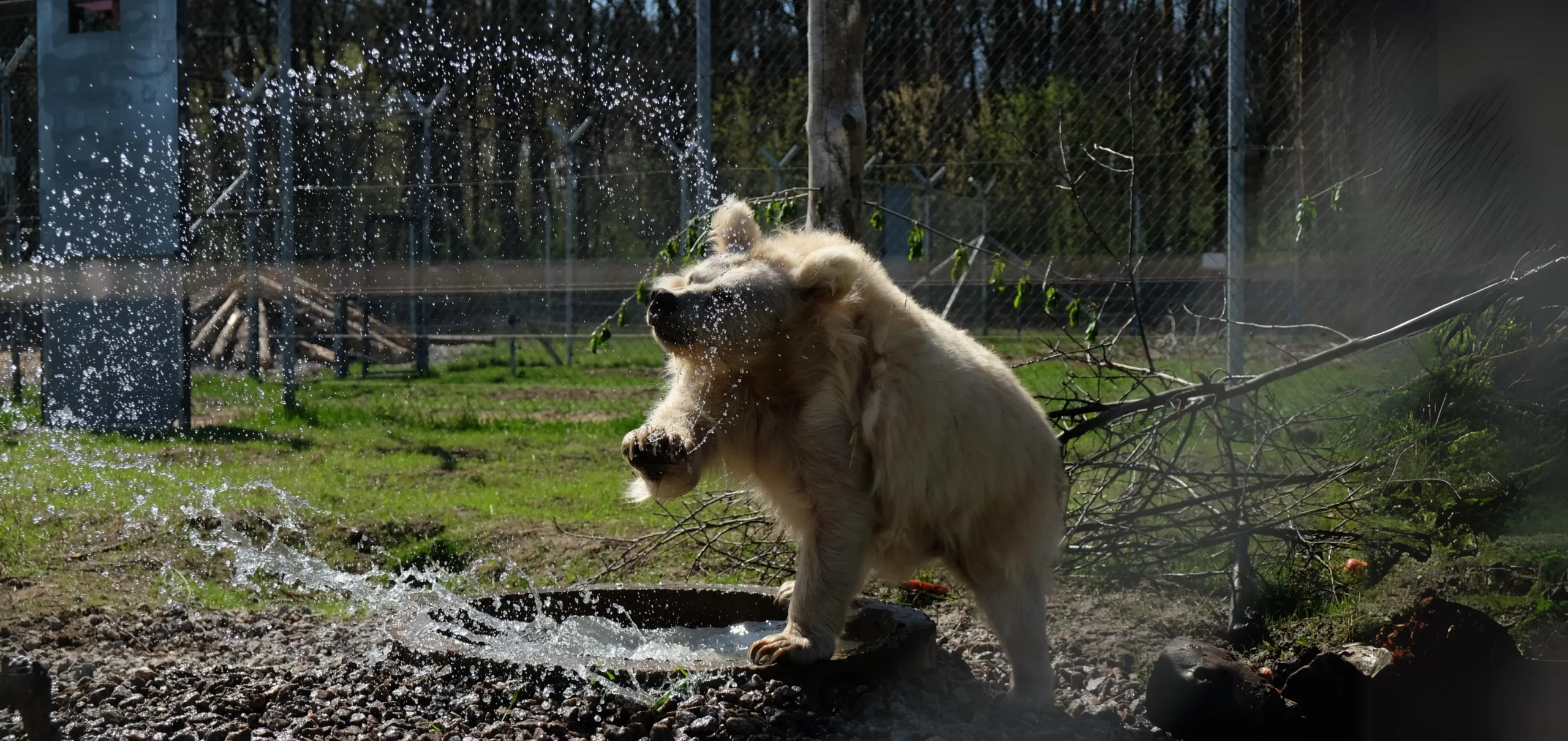
A few minutes by car from Kyiv, you arrive in the village of Chubynske. Here, four bears and a wolf live at the Bila Skelia sanctuary, which means White Rock in Ukrainian. I enter the gates, fully confident that the bears will be somewhere far away and that I’ll only see them through a camera lens with a 5x zoom. If only they would poke their noses out!
However, almost immediately, a nearly 300-kilogram bear named Synochok approaches the fence and watches my every step intently.
“Watching a moving object is a natural behavior for a predator. It doesn’t mean he will attack, but he’s curious. When people come with cameras, he openly enjoys himself. You are potential prey,” says the sanctuary’s co-founder and predator behavior and ecology specialist, Maryna Shkvyria.
Well, it’s good that the bear got curious and approached me. After all, nothing but curiosity would make him leave his important business deep in the enclosure. He has a choice of where to be, when, and what to do. The task of the rehabilitation center for animals rescued from cages is precisely this: to create conditions that help them make choices. It turns out this can be quite difficult.
Climbing, Running, Swimming, Chewing
There is no actual rock at Bila Skelia. However, an artificial white rock once stood in the enclosure where bears Liubochka and Mykhasyk used to live. That enclosure was not here but at a shelter in the Zhytomyr region.
That shelter appeared in Berezivka back in 2012 and was initially called Hope. The international foundation Four Paws managed it, which later founded another bear sanctuary, Domazhyr, in the Lviv region. Consequently, Hope came under the care of the Save Wild Foundation and became the Bila Skelia sanctuary. Some of the bears there gradually moved to Domazhyr. Bila Skalia was then developed at a new location in Chubynske, and operations began in 2020.
“It was difficult,” says zoologist Yehor Yakovliev, Maryna’s husband and co-founder of Bila Skelia. “We drew the sketches of the sanctuary with Maryna, and I did the more precise planning and calculations. Then, the plumbing and welding work began, which I and nine other people carried out. We transported the bears in 2020, too. While they wintered in small enclosures, we built the large ones. We worked all year.”
Synochok looks at me from behind the net. Though he is clearly visible, he is separated from me by a 3.5-meter-high fence and two layers of Electric shepherd is an electrified fence that does not allow animals to go beyond a certain area.
electric shepherd. Safety is the number one concern in the design of bear enclosures. In addition to visible fences, there are also hidden ones.
Yehor explains, “There is also a net in the ground so the bear cannot dig a way out. A bear is a compulsive animal. For example, if it senses water flowing underground, it will dig very long and persistently, breaking structures. A bear can remove a cubic meter (35 cubic feet) of soil daily. It’s a big challenge for us to fix everything they break.”

Inside each enclosure, there is a small pool and a den. Bears love interacting with objects and feeling different textures, so the enclosure has plenty of logs, branches, and stones of various shapes that the animals can move around in various ways.
Synochok had never seen anything like this before.
He spent nine years in a circus cage and first set foot on the grass at the sanctuary in the Zhytomyr region. Here in Chubynske, he started making himself at home: he moved stones and logs around to rearrange his den.
Maryna Shkvyria says, “A bear in a rehabilitation center is not a wild animal. It doesn’t know competition with wild relatives, doesn’t hunt, doesn’t live in large territories, and doesn’t fight for a mate. However, a bear still needs to exhibit natural behavior: climbing, running, swimming, chewing, digging the ground. And for this, we create semi-natural conditions.”
Less Is More
What makes an ideal enclosure? The Guidelines for Keeping and Breeding Wild Animals in Captivity and Semi-Free Conditions, for example, require an enclosure for one bear to be at least 200 square meters (2152 square feet).
The residents of Bila Skelia have plenty of space. Except for Chada’s pool, which looks more like a jacuzzi. Sometimes visitors glance at the small pool sideways: maybe she needs a bigger one?
“Chada’s pool is small so that she doesn’t drown. If something happens, we can’t pull her out by the scruff, but if we sedate her with a
A syringe dart is a tool used by veterinarians to administer injections to animals from a distance. Some syringes are thrown by hand, while others are launched using a pneumatic device. dart syringe, she’ll drown before we can reach her,” explains Yehor.
Standards for keeping bears in developed countries don’t require larger spaces or deeper pools. Like in Ukraine, documents only outline minimum requirements for animal care.
To make a bear’s habitat in captivity comfortable and safe, the specific needs of the furry tenant must be considered. A bear cub to be released into the wild requires one set of conditions, while an old, injured bear needs completely different ones.
In developed countries, professional associations directly influence who keeps wild animals in captivity and how they do it. They issue licenses or fine irresponsible owners. Such associations, Yehor asserts, monitor not only compliance with regulations but also the safety and comfort of the animals. In Ukraine, this process is controlled solely by government agencies. Since not every employee is an expert in wild animal behavior, prohibitions or permissions are mostly based on numbers alone.
Tasks of Reconfiguration
The sanctuary currently has five enclosures, one of which is unfinished. So-called boxes, small enclosures for veterinary procedures, are attached at the edges.
“We don’t have direct contact with the bears. We don’t enter their enclosures — it’s dumb and dangerous. All the enclosures and boxes are connected through gates that we can open remotely. This allows us to move an animal to another enclosure if needed and enter the vacant one to clean, for instance,” explains Maryna.
These bear relocations resemble a game of sliding puzzles. For example, if you need to bring a log into Synochok’s enclosure, Chada, who lives next door, is asked to move into the box connected to her enclosure. Then Synochok is coaxed into Chada’s enclosure. Workers can enter the vacant enclosure once the gate behind the animal is closed. But how do you “ask” a bear to move?
“This is where veterinary training comes in,” explains Maryna. “When an animal is under human care, you inevitably train it to do something, like responding to its name. When we call the animal by name, the bear knows that it will get a treat if it comes to the box or another enclosure. It stays there for a while and then returns to find more water in the pool, a new toy, or something else enjoyable.
There is also target training. This method uses a predator’s natural reaction to an object. The target is an item shown to the bear. We attract the bear’s attention with a ball on a stick. It comes to the box, and we carefully give it food with special tweezers. Next time, we show the target, and the bear understands: ‘Oh, great, I need to move, I’ll get fed, and meanwhile, my slaves will clean up my home.’”
Bears are also trained to respond to gestures. For example, at Bila Skelia, closing and opening a fist is a request to show teeth. In other centers, animals are sometimes asked to stand on their hind legs and show their front ones, or lie down. This helps veterinarians quickly examine the animal from a distance before deciding on sedation.”
Wild Relationships: Abuse and Love
In the enclosure next to Synochok, there’s a commotion. Something heavy splashes into the pool. It turns out that two bears, Liubochka and Mykhasyk, have jumped into the water simultaneously. Liubochka was rescued from circus performers along with Synochok, while Mykhasyk lived in a cage at a restaurant complex.
Mykhasyk was taken from the restaurant in 2017. He was an apathetic, depressive, melancholic young bear, recalls Maryna. A year later, Liubochka arrived, then a two-year-old cub. Initially, she was also very stressed because she had lived without her mother, and bear cubs find orphanhood very difficult. Liubochka would bang against the cage, jump, and fall. The sanctuary decided to introduce Liubochka to Mykhasyk while they were still adolescents. The two quickly bonded.
Maryna says, “In their relationship, Liubochka is the leader. In nature, females are often more active and compulsive, which is true not only in bears. Liubochka always checks things first and then brings Mykhasyk along. If she fixates on something too much, he distracts her. He hugs her, sleeps next to her, calms her down. He might even give her a slap. There is abuse among bears, after all: the stronger one is the leader. However, since Liubochka is emotional and energetic, she sets the tone of the relationship. If Liubochka wakes up in the middle of winter, she’ll wake Mykhasyk because she’s bored. If she wants to swim, she’ll approach and push him into the pool. Sometimes Mykhasyk reaches for an apple in the pool, and Liubochka sneaks up on him and kicks him in the ass! He goes into the pool! While Liubochka runs away.”
In the wild, bears live solitary lives. Despite this, they sometimes display behavior akin to friendship. For example, an old and a young bear might travel together in search of food.
Usually, bears practice “free love,” but some pairs always meet during the breeding season and can maintain relationships for decades. There are also so-called spring and autumn romances: young bears that are not yet ready to mate just walk together.
Wolves, too, occasionally live at Bila Skelia: there was a polar wolf named Dzha and a gray wolf named Dora. Dzha passed away, and Dora moved to Greece, into even better conditions. Currently, a separate enclosure is occupied by Nymphadora, a half-wolf, half-dog. Poachers took her from her den as a cub. When the grown animal began to show aggression, the owner gave her away to activists.
“I see your nose, come out!” calls Maryna, but Nymphadora doesn’t want to come out of her den. Relationships between bears and wolves vary.
Dzha was friends with the bears. “She and Liubochka used to race each other!” recalls Maryna. “With gray Dora, there was no reaction. However, Liubochka wanted to play with Nymphadora, but the wolf got scared. She’s still getting used to her neighbors.”
Stereotypy in Bears
Liubochka approaches the fence, shifting from one paw to another. This is stereotypy — repetitive movements that an animal might perform to cope with stress. Animals that have lived in poor environments — cramped, dull places where they have nothing to think about or engage with — are particularly prone to stereotypy.
As Maryna explains, “Stereotypy is part of natural behavior. However, when an animal lives in unacceptable conditions, this behavior becomes more frequent and intense, sometimes leading to self-harm. Stereotypy won’t disappear entirely — the issue is the frequency and intensity of its manifestations. Maybe Liubochka is showing stereotypy now in response to positive stress: she’s curious about our dog, wondering where the bucket was taken… Most importantly, she’s not in a cage, so she can stop and do something else at any moment.”
It’s crucial to give the animal the opportunity to choose: to hide in the den if they want, to come closer to visitors if they want, to rest, or to swim. “The most important thing that circus animals lose is the ability to choose,” says Maryna. “They live in cages and don’t have the choice of where to sleep or when and what to eat. Now they have a choice. But for many rescued animals, it is very difficult to act independently and in a more natural manner.”
There’s a splashing sound coming from the next enclosure. It’s Chada, a Tien Shan bear — an endangered subspecies — splashing around in the pool. Chada spent 20 years in a cramped cage, 12 of which were in a circus.
Chada arrived at Bila Skelia in 2019. Now 26 years old, she is considered quite a respectable age for a bear. The caretakers say she acts like a fussy grandmother. Unlike the others, Chada couldn’t care less about me and my camera. She’s focused on splashing in her mini pool.
This behavior is a remnant of stereotypy, which transitioned into a softer form. In this case, it plays a positive role: it keeps the old animal active and prevents apathy.
Yehor explains, “She has her own ideas about the water level in the pool: Chada stops splashing at a certain level. Sometimes, she lowers her head and checks: if the water is too low, she snorts and shows her displeasure, as if to say, ‘Servants, replenish my water.’ They all see us as their servants.”
How a Bear Played a Joke on the Electrician
Whenever I try to film Synochok up close, he turns his back on me. It’s his sense of humor, Yehor and Maryna suggest. Do bears really have a sense of humor?
“They find something primitive funny, like ‘someone slipped on a banana peel,’” says Maryna. “They get happy when you drop something or trip. Bears have this experience, too: they fall, and you can see they can extrapolate it. They see you climb a ladder and watch. If you fall, they are delighted. If they have a chance to shake the ladder, they will.”
“They once had such an opportunity,” Yehor shares. “An electrician was working with cables on a ladder near the box where Mykhasyk was. I was standing nearby to ensure everything was safe. Mykhasyk approached, stretched out his paw, covered it with his other paw, and reached for the ladder to yank it. I noticed this. The electrician got down, and we moved the ladder. Mykhasyk was so frustrated! He even turned away. He didn’t like that his joke was ruined.”
This isn’t the only such instance, Maryna laughs:
“Bears quickly get used to the electric fence. Some never touch it. Once, we closed the bears in the small enclosures and were working in the large ones. Our dog Rafik came with us and was walking near the electric fence. The bears realized there was a chance Rafik might get into trouble. They gathered in a row and held their breath, trying not to scare him. The dog eventually ran into the electric fence, and they jumped joyfully because they figured out how the system works.”
“Once, we had young bear cubs, and until a certain age, we would enter their enclosure,” Yehor continues. “They always tried to knock a person out. One would distract you while the other approached from behind to push you. For them, it’s a game.”
“There aren’t any complex abstractions here, but it’s already humor. It’s also a sign of intelligence,” concludes Maryna.
Bear Appétit
There is probably no other large animal around here with as varied a diet as the bear. Bears are omnivores: they can feast on both plants and meat, depending on what they find. In search of food, they spend most of their active day and can walk up to 40 kilometers (~25 miles) a day. Therefore, even in semi-natural conditions, you won’t see a dedicated feeder for a bear.
“We need to support their natural feeding behavior,” says Maryna. “Several times a day, we scatter different types of food around the enclosure so the bear has to search for it, just like it does in the wild.”
A significant part of the bears’ diet at the sanctuary consists of seafood, as well as vegetables and fruit: carrots, apples, oranges, pumpkins, and watermelons. Additionally, nuts, boiled eggs, occasional meat, cottage cheese, and a bit of dog food (for its mineral additives) are included in their diet.
“If it’s food we give only every few days, we enter the enclosure and hide it. Sometimes, we freeze fruit or fish in water and throw the ice into the pool for them to retrieve. Sometimes we bring fish in a wheelbarrow and place it under stones. It starts to smell, this grossness. They love that… Bears can even hide their food to let it age. They do this in the wild, too. So, if you see a dead deer covered with twigs, you better run,” Maryna explains.
A Bear in a Rehabilitation Center: What’s the Point?
When a bear that needs to be rescued or whose owners are giving it up is identified, sanctuaries and rehabilitation centers look for a place for it. The organization that has the appropriate conditions and expertise takes in the animal. Rescuers communicate with the owners and prepare the veterinary documents for transportation. They arrive with veterinarians who quickly examine the bear and administer sedation. The bear is transported in a special transport cage. Once at the rehabilitation center, the bear initially stays in a small enclosure to gradually get used to the new conditions. Only then does it move to an enclosure proper: first, a small one for adaptation, then a bigger one.
“We sign an agreement with all owners that they will not keep bears anymore. We aim to indirectly preserve the species by reducing the demand for keeping bear cubs. Therefore, we do not take a bear if we know that new ones will take its place,” Maryna explains. Yehor adds, “We want to contribute to the formation of civil society. Such people will not remain silent when they see animals being kept in terrible conditions.”
The co-founders of the sanctuary emphasize that proper rehabilitation involves more than rescuing an animal from negligent owners; it involves more than simply transferring it from one cage to another.
“This is a field based on science and standards that must not be violated,” says Maryna. “The number of animals kept in unacceptable conditions in captivity does not change. However, there are changes in attitudes. It is now frowned upon to go to a restaurant with a bear in a cage, and in large cities, people have started to look down on circuses with animals. The UAnimals campaign to ban traveling circuses with animals has been effective. The existence of bear sanctuaries — such as in Domazhyr and the Synevyr Park — has also made an impact. People visit rehabilitation centers and then question why a bear runs in the grass and winters in a den in some places, while elsewhere, it sits on concrete in a cage. They write about it on social media. People are gradually changing their attitudes toward wild animals in captivity.”
Content


