



 01.05.2024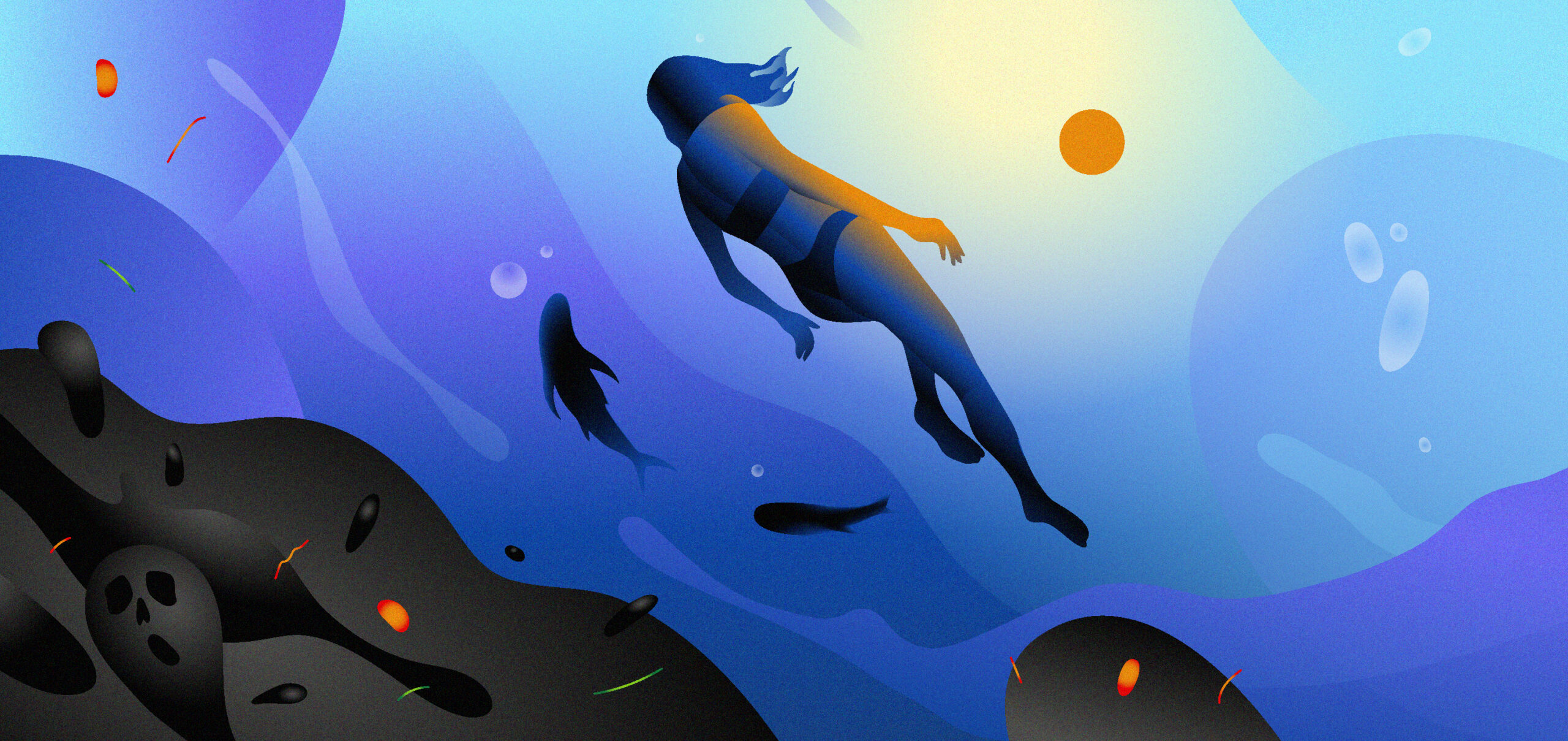
— Skagerrak Strait. Gotland. Bornholm…
I remember reading these names syllable by syllable and placing the map on my lap again. It’s my longest journey to the north. Sitting in the passenger seat, I watch the densely grey waves of the Baltic Sea inlet pass by the window. Soon I’ll run into the Little Belt strait. I’ll splash in the cold waves and have no idea that hundreds of thousands of tons of poisonous shells lie somewhere on the bottom beneath me.
Every day, nature gets new wounds from warfare: forest fires, sea, land and air pollution. And the old scars are far from being healed.
Baltic Sea: 300 thousand tons of chemical weapons
What to do with unwanted ammunition? This question arose among the Allies after World War II. They decided to get rid of unused weapons in a seemingly quick and cheap way — by simply dumping them in the Baltic Sea. How it would affect marine life, and therefore humans, seemed to be of little concern in the forties.
It’s not known exactly how many munitions were dumped into the sea and where exactly. According to available data, most conventional munitions were sunk near Germany — over 100 thousand tons. Chemical munitions were dumped into the Little Belt and Skagerrak straits, as well as the basins around the islands of Bornholm and Gotland. The sea absorbed about 300 thousand tons of chemical munitions.
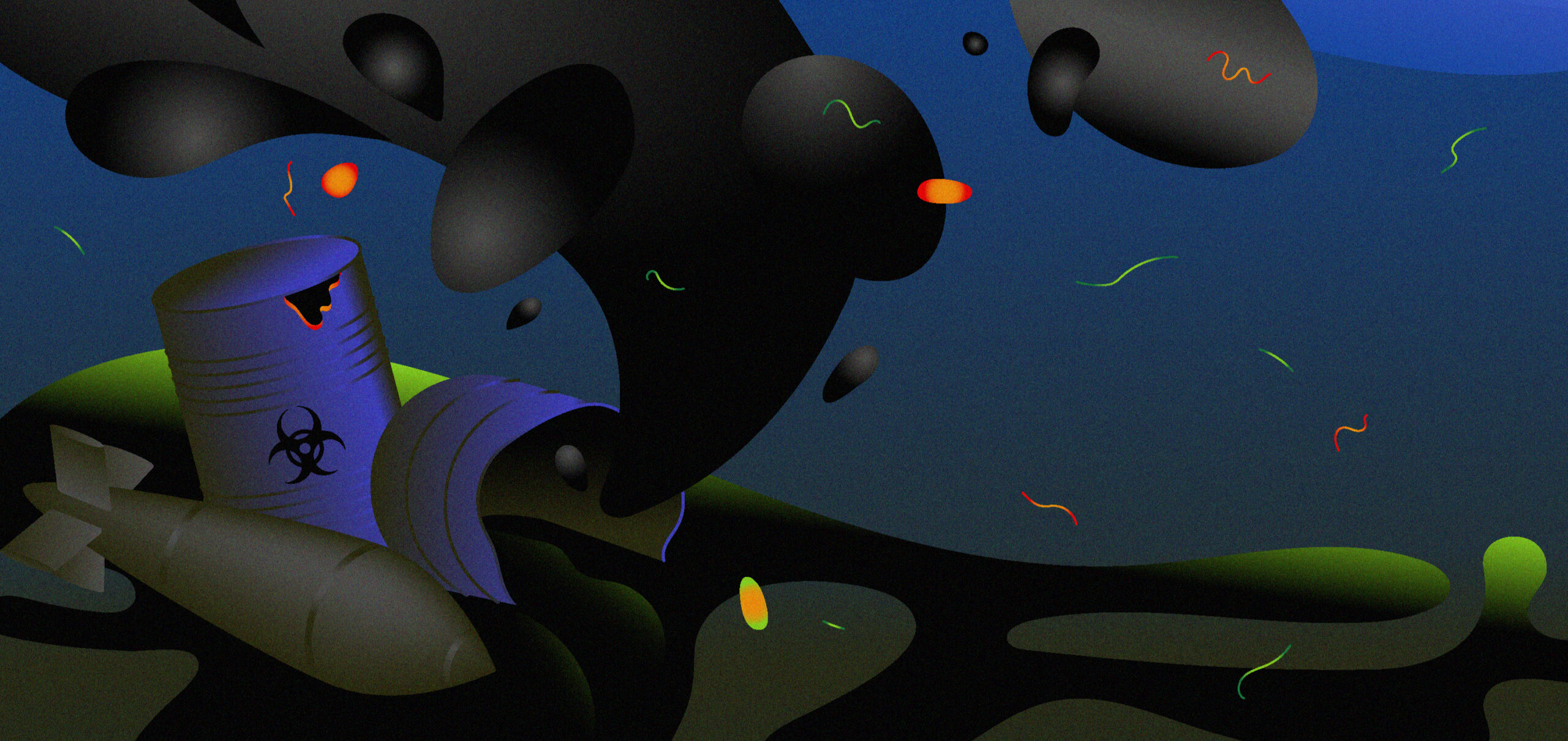
This horrifying “tradition” continued to be followed long after the war. For example, in 1961, the German government dumped cylinders with chemicals in a bay near Lübeck — just 8 kilometres from the coast. The cylinders contained chlorine, phosgene (choking gas) and the so-called laughing gas (nitrous oxide, which is now used for anesthesia and pain relief).
All these tanks corrode, slowly releasing their contents into the sea. The main pollutant from conventional munitions is the explosive TNT. It’s toxic to microorganisms, aquatic plants and fish. Releases from chemical weapons create an even more poisonous cocktail in the seawater. For example, it causes cancer in fish and other representatives of marine life. This poses a risk to people who consume such fish.
“Toxins damage marine ecosystems and threaten marine life,” says Terrence Long, founder of the NGO International Dialogue on Underwater Munitions. “TNT can burn corals and trigger harmful algal blooms… Chemicals also affect the photosynthesis of phytoplankton and the development of crustacean eggs.”
It’s not only marine life that suffers.
In 2005, three Dutch fishermen pulled up their nets, but instead of fish, they found munitions there. They exploded, and the fishermen died. And since the war, at least 91 German fishermen have been injured in such incidents.
How to prevent the leakage of toxins? Can we remove munition tanks from the Baltic Sea? These questions haven’t been asked since World War II, but they are acute now. Solutions are just being developed. It is possible that a remotely operated vessel will examine the seabed. Germany has initiated a €100 million project to search for munitions in the sea.
There have also been unsuccessful attempts to neutralize munitions. In 2019, Germany, together with NATO, detonated 42 shells in the heart of a marine reserve in the Fehmarn Belt strait. At that time, dead marine mammals — Phocoena or porpoises — began to appear on the German coast. The public was outraged, and the German Ministry of Defence banned underwater explosions that same year.
In that notorious case, deaths from echolocation disruption were confirmed in a dozen of animals. In 2022 alone, in the Black Sea the number of dolphins killed was estimated at thousands.
The operation of sonars on warships disorients dolphins: they can’t find food, lose weight, and their immune system weakens. Dolphins die of hunger and diseases that a healthy body could cope with. Russian aggression kills not only people.
Ocean: Ironbottom Sound
In February 2001, a typhoon raged over the coral island of Ulithi in Micronesia. When it subsided, the islanders felt a strong smell of oil. Later, one of the lagoons was covered by a huge oily slick. It turned out that the typhoon shook the American oil tanker at the bottom of the ocean, which had been sunk by a Japanese torpedo back in 1944. It made itself known decades later after sinking. In 2001, over 90,000 litres of aviation fuel leaked from the USS Mississinewa tanker into the ocean.
The US cleaned up this slick and pumped more than 7.5 million litres of fuel from the ship’s tanks, but there was still more left. Millions of dollars were spent on the operation, but it’s just a drop in the ocean. And unfortunately, that expression isn’t as figurative as it sounds. Governments in the Pacific region have found that over 3,800 ships from World War II lie at the bottom of the ocean. Approximately 50 oil tankers are among them. All these ships and their tanks corrode, releasing toxic substances into the water. And when the rust finally eats through the wall of one of the tanks, oil or fuel leaks into the ocean.
Oils and fuels are not just ugly stains against the backdrop of the blue sea. They are destructive to coastal ocean ecosystems. Moreover, they can harm human health. Toxins are released in areas where fish is caught for Japanese sushi. Local islanders eat this fish, and it’s also served to tourists who come to enjoy the tropics. Such idyllic and pristine, from the outside…
Governments of Oceania countries occasionally remind us that the flora and fauna of coral reefs are dying due to oil leaks from sunken ships. Local residents insist that the responsibility for this should be taken by the US and Japan. Most countries in Oceania lack the resources to raise ships or clean up the sea on their own.
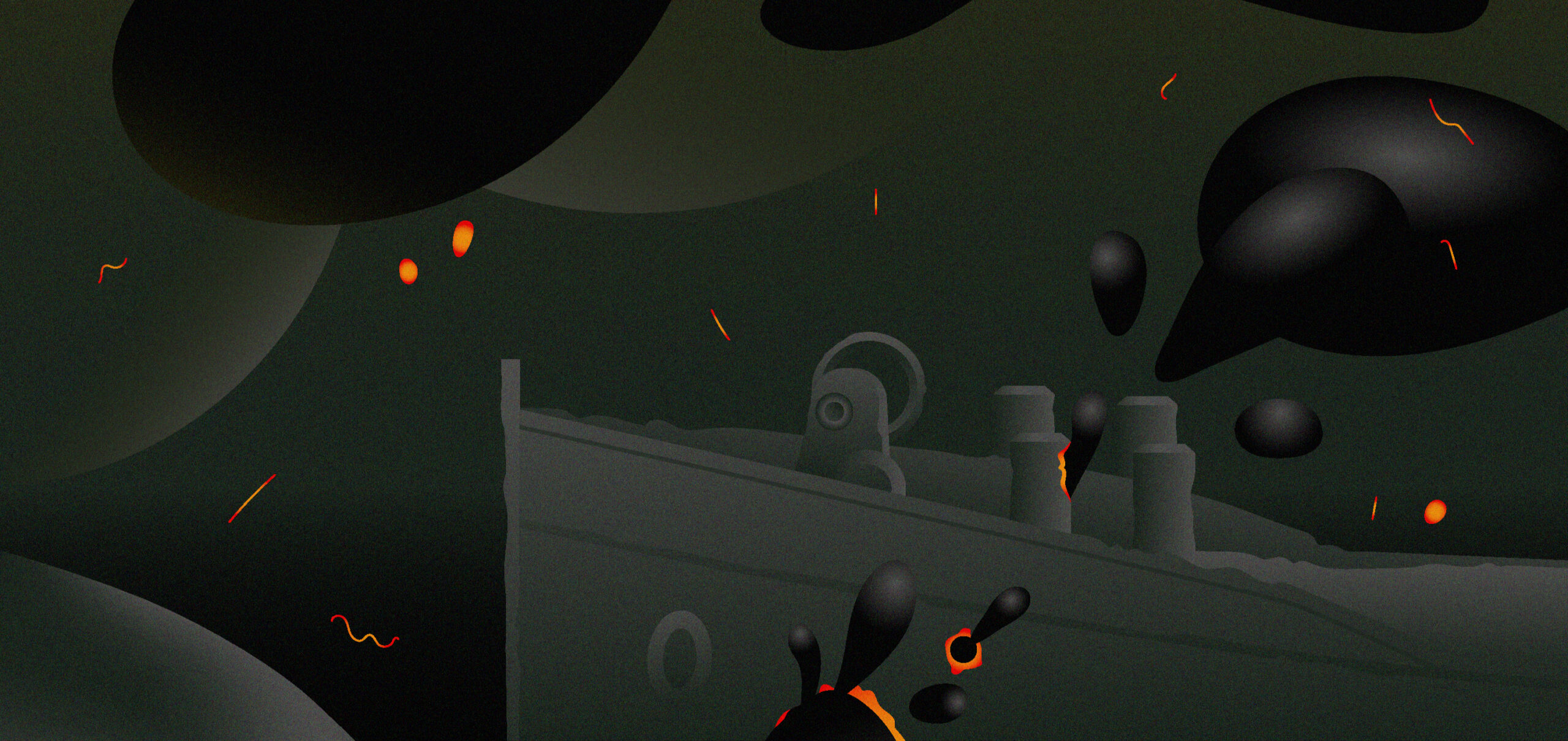
In some places in the ocean, you can find not just single sunken ships, but actual graveyards of ships from World War II.
First of all, it’s the Ironbottom Sound. You can find it on the map in Oceania, among the Solomon Islands, namely between the islands of Guadalcanal and Malaita.
This strait got its name after the war. In 1942-1943, several battles took place here, and dozens of ships and planes sank in the strait. Its bottom became literally covered in metal. Researchers from the South Pacific Regional Environment Programme have estimated that there are 550 thousand tons of metal debris on the “iron bottom.”
Chuuk Lagoon in Micronesia also hides tons of iron. During World War II, Japan chose a small group of islands, remote from the rest of the land, to build a stronghold here. Amidst tropical landscapes, arsenals grew, radars rose, and runways stretched out. The clear Chuuk Lagoon (then called Truk) became the base of the Japanese fleet. Aircraft carriers, cruisers, tankers, submarines — every possible type of warships — were anchored here. In February 1944, American planes took off from the Marshall Islands, approached Chuuk Lagoon and opened fire on the Japanese fleet. After this attack, over 60 ships ended up at the bottom. They sank in a very small area — only 60 kilometres in diameter. So, the lagoon turned into a ship graveyard. You can even see with your own eyes the gruesome wreckage covered in algae and corals. It’s possible if you get to Micronesia and don’t mind wearing a diving suit.
Australia’s Great Barrier Reef is a place of incredible colours and life forms. If no efforts are made, toxins from ship fuel will eventually get there. Not far from the reef in the ocean, two American ships lie: Lexington aircraft carrier and Neosho tanker. Both sank during the Battle of the Coral Sea in 1942. Researchers believe that together they contain nearly 19 million litres of oil.
Sunken ships or their wreckage are a war legacy that is not so easy to get rid of. The fact that missile cruiser Moskva and ship Tsezar Kunikov sank is a welcome development. However, they raise a lot of questions: how and when to raise this debris from the Black Sea, and how to dispose of it? Besides large vessels, the Black Sea is forced to absorb the wreckage of damaged ships, small boats, maritime drones and even the shells themselves. All this poses many challenges for the state and society.
Forests: deforestation, explosions and fungus
“Zelenka [ed.: green area] will protect our soldiers,” I remember this being repeated on social media at the beginning of russia’s full-scale invasion of Ukraine, awaiting spring. The forest covers the soldiers, and the enemy hides in it. The forest takes the hit but receives terrible scars itself. We are witnessing endless forest fires now. Environmentalists claim that about a third of Ukraine’s entire nature reserve fund has been affected by the war.
Combat actions have crippled ecosystems since World War I. It is clear that neither animals nor plants can survive direct attacks. However, it was not fire and explosions that left the longer-term effects, but the deforestation for military purposes. It reached enormous proportions even during World War I. In Britain, there was even a timber crisis. After the war, the British created the Forestry Commission, which undertook to plant new trees. World War II thwarted these efforts, but the Commission did not stop its work. It still operates today.
During World War II, people used more wood than steel, researchers tell about the history of American forests. Barracks, ships, docks, military factories, housing for soldiers, ammunition boxes were built from wood…
The United States, European countries and even Japan were full of deforested or destroyed forests. So, the newly formed United Nations put the issue of forest conservation on the agenda. As part of it, a permanent organisation responsible for forestry was established. It adopted a forest restoration programme. However, decisions on what and how to do were left to individual countries.
Different countries introduced new legislation in forest protection. For example, Japan passed laws on how exactly to restore forests. The deforested areas were mainly replanted with Japanese cedar and cypresses.
Meanwhile, in the United States, a large study was conducted — a kind of audit of forests. It turned out that timber was being depleted in forests one and a half times faster than new trees were growing.
After the war, the American Forestry Association adopted a programme urging more effective protection of forests from fires, increased control over forest pests and diseases, and stricter regulation of logging. In 1947, Congress passed the Forest Pest Control Act, followed by various legislative acts that provided mechanisms for cooperation in fighting forest fires. In 1949, a law was passed for the accelerated restoration of forests.
In Germany, efforts were made to revive not only forests but also large urban parks destroyed by bombings. In Hamburg, linden, maple, birch and oak trees were planted, and by 1980, the city’s vegetation had recovered to pre-war levels. In Dresden, botanical gardens hired boys to search for tree sprouts among the stones. Some of those saved trees are still growing today. However, greenery returned to the city much more slowly than in Hamburg.
In Ukraine, forests were also actively planted after the war. However, they approached it with a rule typical of Soviet times: the more and faster, the better.
You’ve probably walked through forests planted in the 50s and 60s, where pine trees stand in rows. Pine grows quickly, so it was mostly planted, along with fir and spruce. Such forests have an unnatural structure: the trees grow denser than usual, most of them of the same species and age. They are much more prone to disease and drying out than trees in natural virgin forests.
At the same time, World War II brought less obvious consequences for the forest.
In August 1944, American landing craft approached the French shores of the Mediterranean Sea. At that time, the Germans had already occupied France, and the Allies intended to push them away from the coastline. The operation was called Dragoon. It was successful for the Allies: the south of France was liberated. However, afterwards, the local trees began to get sick.
During Dragoon operation, soldiers unloaded ammunition boxes. These boxes were made of plane trees, the wood of which was infected with the fungus Ceratocystis platani.
When this fungus infects a tree, the flow of water and nutrients gradually becomes disrupted, ulcers appear under the bark, leaves wither and the bark becomes spotted. Within a few years, the sick plane tree dies.
North American plane trees had developed immunity to this disease, but European trees were vulnerable to it. In the first 15 years after the war, the plane tree disease did not manifest itself in any way. But then the acute phase began. The disease spread through the length and breadth of Europe south of the Alps, including large areas of Italy, Greece, Switzerland and southern France.
Even decades after the war, the disease was still killing trees in southern Europe. In the Italian municipality of Forte dei Marmi, 90% of plane trees died out between 1972 and 1991. In Greece, where the disease was noticed only in 2003, it quickly destroyed hundreds of trees.
In the French city of Toulouse, the problem affected a UNESCO World Heritage Site — the Canal du Midi. Tourists flock here to see the incredible landscapes: the canal surrounded by magnificent plane trees. In 2006, a deadly fungus was recorded here, and the trees began to die. Over 5 years, along the canal, 2,500 plane trees were cut down and replaced with more resistant species.
Land: Red Zone, the Poisoned Forest
The Battle of Verdun is one of the bloodiest battles in World War I, which took place in northern France in 1916. Over a hundred years have passed, and the battlefield is still covered with craters formed by intense artillery shelling. There used to be farms and small villages here, but now it’s almost an untouched forest. However, you can’t just wander around: access is restricted. And the reason is not the craters.
Firstly, the area between Verdun and Lille is full of unexploded shells.
“Explosions and ground movements during the war have short-term effects, but nature restores itself. And the mined areas pose a threat of pollution for decades,” explains Anastasiia Splodytel, a soil science expert and PhD in geography.
Secondly, chemical contamination of the soil causes invisible to the naked eye, but even more lasting consequences.
“At the site of the Verdun battle, the content of copper and lead in the soil still exceeds the norms for France. There is also a lot of arsenic, especially in the places where ammunition was burned,” says Anastasiia.
Immediately after the war, the French government declared the lands where the Verdun battle had taken place unsuitable for life and agriculture. The most affected areas were called the Red Zone. This is not a continuous area of territory, but separate “spots” on the map near the city of Nancy, further west from Verdun to Soissons, and from there north to Lille.
Over the years, the Red Zone has significantly decreased, as part of the land has gradually recovered. Now it is approximately 170 square kilometres. You can’t live or walk here, and of course, eating plants grown in the Red Zone is prohibited.
Toxic substances from the soil migrate to water, and then to food products, and can therefore end up in the bodies of animals and humans. For example, lead causes neurological development disorders in children, while copper causes respiratory organ cancer.
During World War II, the soil was contaminated wherever battles took place, but there is very little data on this. In addition to shrapnel and explosives, chemical substances got into the soil with the medicines of German soldiers. This is about Losantin (calcium hypochlorite). This substance contains active chlorine, so it can damage plants and change soil properties. Zlatko Zlatanov, a historian and employee of the Second World War Museum, says, “German troops used the so-called chlorine containers, or losantin containers, to decontaminate the body in case of a chemical attack. We have such finds in the museum, they were sent to us. These losantin containers are small boxes containing chlorine tablets. They had such a thing on all fronts.”
There is no information on the chemical state of the land in the 1940s at all: no one just collected it. Therefore, scientists cannot accurately assess the impact of the war. There were no restoration measures either, except for mechanical demining. “I talked to people who were involved in the state restoration processes. There was nothing like that — only the infrastructure was being restored,” says Anastasiia Splodytel. “If they collected any explosive items, they were taken to one field or placed in one pit and buried. And no one still knows how many such places there are on the territory of Ukraine.”
No matter how terrible the land pollution after World War II was, the consequences of modern combat actions will be no less noticeable. “Types of ammunition, characteristics of waging war have changed and become more destructive than during World War II,” explains the researcher. “High-explosive, armour-piercing, phosphorus, and most likely even bacterial weapons are used. That is, they apply the full range of possible impacts, which significantly differs from the technical capabilities that existed in the forties. The shock wave and explosion products spread over a larger area.”
Modern warfare is striking not only for its different power, but also for the quantity of ominous “gifts” left in nature. Potentially, about 30% of Ukraine’s territory is mined, according to the State Emergency Service. This can be compared to the area of Greece or, let’s say, four areas of Switzerland.
It will take more than 700 years to clear the mines with the resources currently available in Ukraine. The good news is that the mines themselves can at least be technically neutralised.
But how to deal with other consequences of wartime activities for the land?
One of the global practices is land preservation. For example, in Denmark and the Netherlands, nature reserves have been established in areas contaminated by military actions.
In Germany, the areas of former military training grounds have become protected. They were actively used during the Cold War. Then, the training grounds became unnecessary. Some of the land was sold by the state to private owners for cleaning and construction. At the same time, about 120,000 hectares were put under protection — as part of the National Nature Heritage programme. For example, these are areas on the island of Rügen in the Baltic Sea or in Saxony, in the natural parks Dübener Heide and Fläming.
***
Before the full-scale war, I was lucky enough to visit Dzharylgach. I swam as far as I could, watching for pods of dolphins. And indeed they were there: diving carefree near the shores of the Kherson region. Will our generation be able to swim there again without fear, splash on the Kinburn Spit or peacefully wander along the shores of Tuzly Lagoons without encountering dead dolphins? Will weapons from the Baltic Sea be neutralised in my lifetime? Will it be possible to eat berries from the forests in northern France? I’m not sure.
Over time, the land, destroyed plants and damaged landscapes will recover on their own. However, to get rid of other war consequences, billion-dollar programmes and many years of work are needed.
Content


