


 29.04.2024
Only 22% of apartments for rent in Ukraine are available for people with pets. This was found out by UAnimals and DIM.RIA during a joint study of the residential rental market in September 2023.
Meanwhile, due to the full-scale invasion of russia, internal migration continues in our country. People move from the occupied or frontline regions to safer places with whole families, often leaving their lifetime possessions at home but taking their pet friends with them.
Today’s article is about how they manage to rent housing in Ukraine and what helps in this. We share the stories of internally displaced pet owners and advice from people with experience in the rental market.
“Is it possible to live with the elderly?”: the story of Rudyk and Baghira’s owners from Bakhmut
Natalia Zubar evacuated from Bakhmut with her large family. When it became too loud in the city [ed.: due to shelling], everyone left: she and her husband, her sister with her son, elderly parents, a male cat, and a female cat. The male cat Rudyk is a village boy whom they took as a small kitten, and the female cat Baghira is a black beauty who came to them for a foster home and treatment after a serious injury, but she was never given to anyone. The pets arrived in ordinary bags to the capital itself, where Natalia’s son, Petro, lived and studied. There, the family started looking for a separate home.
“We tried not to get nervous — we didn’t even look at the ad that categorically stated ‘no pets’. But still, there were strange preconceptions. For example, one realtor said that traces of cat urine were visible under ultraviolet light. And if one of my little ones [ed.: pets] ‘messes up’, even if I clean it right away, it won’t be possible to rent out the apartment to anyone afterwards. I just imagined how people who want to rent an apartment walk around with ultraviolet light and look for traces of cats,” says Natalia.
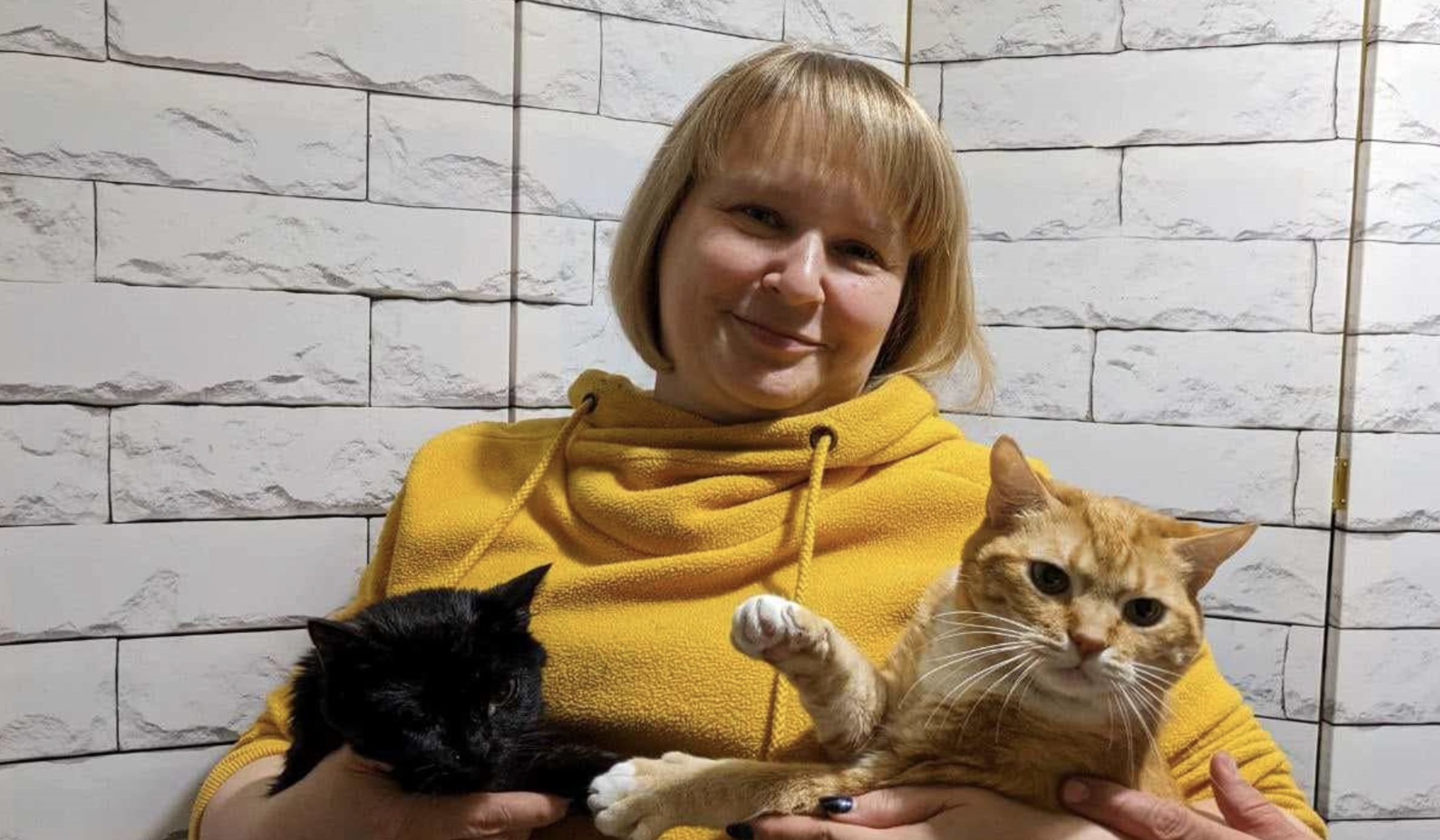
Eventually, the family found a rather spacious three-room apartment – the kind of apartment that is usually described as “in need of repair”. In order to live in more or less comfortable conditions, they really made the repairs. But they still remember the process of looking for housing with a nervous smile.
“We always asked cautiously: Is it possible to live with the elderly? And with pets? And with a disabled person?” says Natalia, who has been using a wheelchair for many years. “Sometimes the conversation didn’t even end with cats.”
Natalia says that anything can happen. Recently, a parrot flew onto her son’s balcony, which either escaped or was deliberately set free. There was no pet clause in the lease agreement, but the owner of the apartment was moved by the story that the parrot had chosen her apartment on its own and did not demand that he be evicted.
Advice
Antonina Semenova, a homeowner: “Look for different options. In my case, for example, tenants without pets and children consistently ‘killed’ apartments more than ‘a herd of horses with 3 senior kindergarten groups.’ Therefore, if in the future I rent out my apartment in the suburbs of Kyiv again, I will write ‘only with children and/or pets’.”
Kateryna Honchar, a tenant: “For these almost two years, I have changed housing three times. I have two cats. When I searched with the help of realtors, they asked for a deposit of $1,000 for the animals. Those, who did not plan to move but were forced to flee the war, do not always have such ‘extra’ funds. But this is not the only way. In the previous apartment, under the condition of a long lease, our pets were given a trial period of 3 months. They are well-behaved, so everything went well.”
“Oh, do you have cats? No way”: the story of owners of a cat and kittens from Siversk
In April 2022, Yuliia Deineko evacuated from the town of Siversk in the Donetsk region to the village of Horyn in the Ivano-Frankivsk region. And a year later, the family moved to the capital, as the children were enrolled to study there. They also took their big cat family to Kyiv — a mother cat and her newborn kittens.
“We knocked about hostels for a long time, moved and tried to rent housing. It didn’t always work out,” Yuliia recalls. “When we were looking [ed.: for the house], one realtor assured us that we would not find anything with cats. She told us to hand them over to a shelter, and there would be no problems. But I couldn’t do that!”
Yuliia calls those times of looking for a place to live the circles of hell because she was in despair from constant insults, hints about the possibility of getting rid of pets, emphatic refusals and scare stories about the inevitability of damaged wallpaper or destroyed parquet.
“These words are still in my ears: ‘Oh, do you have cats? No way…’,” says the woman. “I think we were lucky: the owner of the apartment was urgently renting it out because she was moving. I was constantly monitoring the announcements, and as soon as a new one appeared, I immediately called. We met, talked and agreed on the cat issue. She has a cat herself, so she treated our pets normally.”
The family rents an apartment on the left bank of Kyiv. They live together with cats that have not damaged anything.


Advice
Olena Vincent, a tenant of housing in Georgia: “In Batumi, there is much more housing than those who want to rent it. In new buildings, there are residents in at most one-third of the apartments. Over the past six months, a lot of people have left Georgia, the high season is far away, and it is not necessarily true that it will be at all. Therefore, the prices are falling, and the owners are happy to find people willing to rent their housing. Half of my friends rent apartments with dogs, two friends — with four cats, and I — with three cats and a dog. And we are talking about more or less new, good apartments. Housing in Soviet conditions [ed.: home improvements] or without appliances is rented out very rarely here.”
Olena Antipova, administrator of the Facebook group for finding housing for tenants with pets: “I would advise you to write as much detail as possible about yourself, your pet and the housing requirements in the ads. Tell where you are from, where you study or work, in which location you are looking for housing and how much you are willing to pay. If possible, add a photo of your pet. I remember one case when an apartment after renovation was rented with a “no pets” condition. A girl with a dog came to watch. After seeing her [ed.: a dog], the landlady agreed. Unfortunately, not everyone is so lucky. Finding housing with pets is very difficult, but possible.”
“We decided to take a puppy”: the story of a doctor and a soldier who travel around the frontline regions with a dog
Daria Volkova is the last doctor who left the semi-surrounded Soledar. She helped people who stayed in their hometown in shelters and basements. She already evacuated wearing a bulletproof vest, which her 13-year-old beloved cat Archie clung to. Daria recalls that this helped her pass the checkpoints quickly: a tired woman with red eyes and a frightened cat around her neck answered all possible questions only with their look.
“We drove to Pokrovsk, where a friend put me in an empty three-room apartment near the railway station, regardless of the cat. Archie survived a month with me in Pokrovsk. And then there were three more happy months with my parents at a rented dacha [ed.: summer house] in Poltava. One night he left and never came back. Perhaps his time had come. This is still my great pain,” says Daria.
Her husband Oleksii joined the Armed Forces of Ukraine. His path is also the path of Daria, who has lived almost along the entire front line over these two years.
“I changed houses every 2-4 months. I remember it like in a kaleidoscope. When I lived in Sloviansk, we decided to get a fox terrier puppy. We were looking for this particular breed because my husband has childhood and teenage unmet needs,” smiles Daria. “And Tobik turned out to be a salvation for both of us — for me, so that I wouldn’t go crazy from everything that was happening around, and for him — a kind of rehabilitation. The dog helps to survive everything. I can’t describe how he waits, meets and loves Oleksii!”


Daria says that renting an apartment with a dog is not easy. Especially considering the fact that it has to be changed often. Now they live in the Kharkiv region.
“It took incredible effort to rent a private house. We deliberately looked for a house with territory in order to let the teenage dog out and train it to use the toilet,” the woman says. “When we settled in, during the inspection of the house and territory, it turned out that only the concrete path to the gate was ‘fixed’ for us, and everything else belonged to the owner, who lived nearby behind the fence. Although the ad promised 3 hundred square metres of land. We had to look for another place to live.”
However, Daria recalls that incredible stories also happened. Once she rented a house on the territory of the manor the size of a recreation centre. The owners, a married couple, loved the dog as their own and allowed him almost everything. Daria remembers this sincere humanity with gratitude.
“I think we did everything we could for our pets. Sometimes I watch ‘dog groups’: people abandon pets and leave forever. Sometimes they leave them on a chain. Perhaps they are afraid, in particular, of these difficulties with finding housing…”
Advice
Olha Kononenko, a friend of a tenant with an animal: “My friend once submitted an ad on social networks on behalf of her cat, and everything worked out. He wrote something like this in the introduction: ‘My name is Dzhanho, and I am a cat. I’m a pretty smart cat as I manage my social media pages by myself. Yep, I know how to do it, and how am I worse than my human roommates who do just that all day long: tap-tap, tap-tap on a laptop keyboard?’. This text was funny, but it contained information that was usually of interest to apartment owners. For example, the cat complained that back in his early childhood he was deprived of the very thing that some people associated with dignity. Therefore, he does not mark the territory and smells only of shampoo. It was creative, original, and it helped.”
Natalia Adamovych, a tenant: “Hiding that there are pets, in my opinion, is not okay at all. The only thing is that it is easier to talk about them already during the meeting. When landlords like a potential tenant in communication, they become more accommodating in some matters.”
Comment from expert

Natalia Birova, Real Estate Management Specialist
For tenants
In our country, it is currently difficult for pet owners to rent housing, so I advise you to offer an increased guarantee payment if possible. In this way it is often possible to convince even those who write in capital letters “NO PETS” in the ad. It’s not just about the money — this way you’ll show a conscious sense of responsibility.
In my memory, no one has ever said: “Yes, my pet can damage something.” But I know such cases when pets that have lived in an apartment for 10 years and have never damaged anything, start to cause damage in new conditions. You should be ready, both morally and financially, to be responsible for the consequences. Even if the owner of the property is pet-friendly and does not demand a double guarantee payment or compensation for damaged property.
You can provide recommendations from your previous place of residence, which is a huge advantage. Sometimes people say that they are ready to invite [ed.: a landlord] to the apartment where they currently live, give the contact details of the current owner and even send videos and photos of the apartment. It works.
In no case should you persuade the owners. It is better for you to look for the right person. Because this violates the equality of relationship: people, feeling that you simply have nowhere to go, often start, as they say, “hoovering”. Even if you are really in a hopeless situation, don’t talk about it. You are not an unfortunate person who out of pity was allowed to live with a pet, but a tenant who pays for a service by mutual agreement.
For landlords (landladies)
I advise you to communicate with future tenants, be interested in their history and assess their adequacy and responsibility. In particular, it is worth learning about people from various sources — from open registers to feedback in groups. From my experience, it is people who damage property much more often than pets. The order in the house will depend on people, not on the pets.
Carefully prepare an agreement, with all the details specified. The agreement should protect both parties — you and the tenants.
Immediately arrange for regular visits at an agreed time. Once every month or two, you should check what is happening with your property, so that it does not turn out to be completely ruined in half a year. Usually, tenants with pets offer you to visit themselves to make sure everything is okay.
Specify mandatory cleaning after eviction. The next tenants may be allergic, and the previous stay of a pet in the apartment should not harm them and your business in general.
Content


